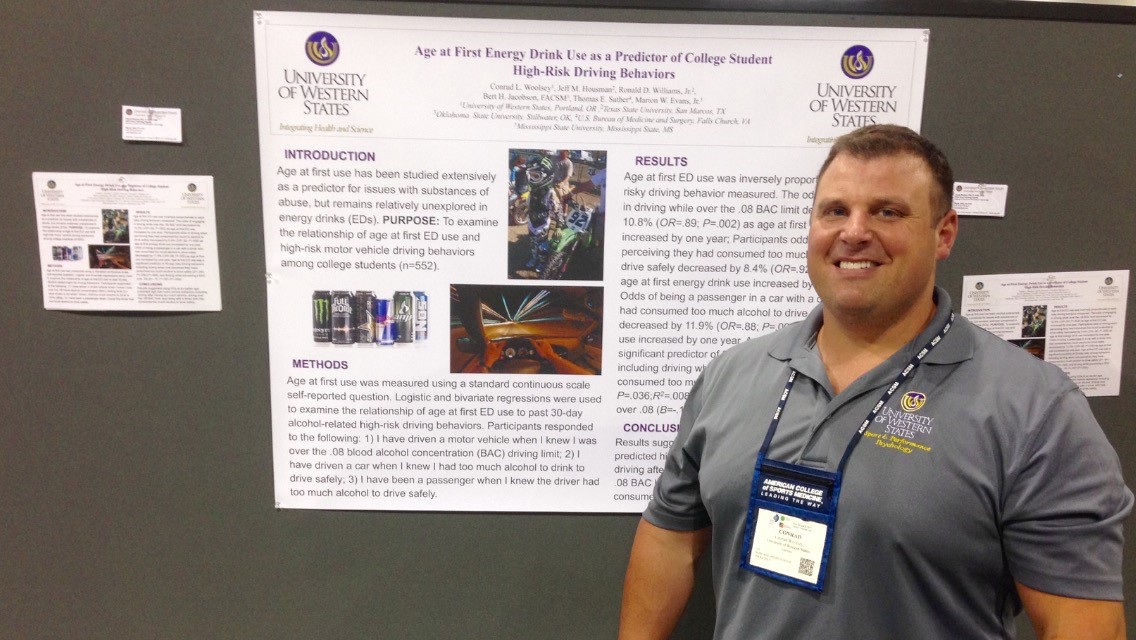
Dr. Woolsey Study Published and Presented at ACSM Annual Meeting

Conrad ACSM

Conrad Woolsey, PhD, director of sport and performance psychology at University of Western States (UWS), recently presented his study, “Age at First Energy Drink Use as a Predictor of College Student High-Risk Driving Behaviors,” at the American College of Sports Medicine’s (ACSM) 64th Annual Meeting in Denver, Colo.

Dr. Woolsey was also recently published in the Journal of Child and Adolescent Substance Abuse. The article entitledAge at First Use of Energy Drinks Associated with Risky Alcohol Related Motor Vehicle Behaviors Among College Students,” was from the same dataset as the presentation, but separate analyses were undertaken.

Dr. Woolsey was the lead investigator on the study used for the presentation and the paper, but he partnered with co-authors Jeff Housman and Ronald Williams (Texas State), Bert Jacobson (Oklahoma State), and Thomas Sather (U.S. Bureau of Medicine and Surgery) to gather the findings.

In the team’s study, the researchers examined energy drink age at first use and high-risk motor vehicle behaviors among a sample of 468 college students. The team found that the younger participants consumed energy drinks, the more at-risk they were for high-risk motor vehicle behaviors such as driving while intoxicated and knowingly choosing to ride with someone who they knew had too much alcohol to drive safely. Thirty-two percent of participants reported driving when they knew they were too drunk to drive safely with the odds of driving while drunk decreasing by 15.2 percent per year that age at first energy drink use increased.

Approximately 40 percent of participants reported being a passenger when knowing the driver had too much alcohol to drive safely. Age at first energy drink use was also a significant predictor of the odds of riding with someone who had consumed too much alcohol to drive safely, with the odds of knowingly riding with someone who was drunk decreasing by 14.9 percent as at first energy drink use increased by one year.

To read the full article and the researcher’s findings visit Taylor & Francis Online.

The UWS Downtown Clinic: A Passion for Caring for the Underserved

At University of Western States, students, faculty, staff and alumni all know the university motto, “For the good of the patient.” But how does the motto translate into real-life practice? At UWS, students are educated in a whole-person approach to health care, which includes diagnosis, adjusting skills, psychological therapeutics, rehabilitation, nutrition and lifestyle management, but UWS faculty and mentoring clinicians also take great care to ensure students develop compassion, empathy and respect for all patients who go to them for help.

To establish this robust foundation of practical experience, UWS operates four health clinics in the Portland area and affiliates with other local clinics that serve patients who often do not have access to medical care. Beginning in the eighth quarter of their education, chiropractic students work as interns and provide supervised patient care in these clinics.

In addition to providing students with hands-on patient care experiences before graduation, the clinics provide measurable benefits to many underserved patients in Portland.

Health Centers by the Numbers infographic

GUIDING PATIENTS WITH SELF-CARE HABITS 

As one of four UWS health centers, the downtown clinic is part of the Coalition of Community Health Clinics and serves underprivileged and underinsured patients in the Portland area.

From July 2015 to June 2016, the downtown clinic provided a total of about 6,000 patient visits. More than 98 percent of those visits were for patients with limited access to health care services. Many patients who seek treatment at the downtown clinic are living with a number of health concerns, often experience chronic pain, and often have limited access to pain management measures. Just a few office visits provide significant improvement in their quality of life and well-being.

“We make sure low-income and underinsured individuals have the same care as other patients,” said Dr. Amy Reynolds, an attending physician in the clinic.

“At UWS, we want our students to not only understand how to diagnose and treat, but also to understand the importance of empathy and their role as healers.”

Dr. Owen Lynch has been director of the downtown clinic since 1989 and he finds the direct impact of the work done at the clinic incredibly rewarding.

“There have been many cases where we have helped patients rehabilitate an injury or chronic condition that they never thought would heal,” said Dr. Lynch. “But our work had a direct impact in improving their quality of life.”

Harriet Block is an example of one of these patients. Block suffered a mini-stroke two years ago and was unable to lift her right foot high enough to walk. With the help of Dr. Lynch and the work of the chiropractic interns, and her dedication to following recommended supplemental exercises for balance, she is back on her feet.

“I know they are short on time, money and facilities, but you would never know it from the care that I was given,” said Block. “I am so happy I found Dr. Lynch.”

Besides using office therapies, Dr. Lynch also focuses on helping patients develop self-care habits. Simple lifestyle changes have the power to make a significant impact in improving the health and well-being of someone who does not receive regular health care. An approach that Dr. Lynch likes to use is working with patients to create SMART health goals, which stands for specific, measurable, achievable, relevant and time-bound. Dr. Lynch uses and teaches these guidelines to determine what motivates patients to help end their pain and reap the benefits of the clinic’s care between visits, and after treatment has concluded.

Dr. Lynch works to instill this focus in his students and encourages them to take an interest in each individual patient’s history to get the most out of the experience in the clinic.

“Dr. Lynch’s expertise in documentation and communication with other health care professionals has prepared me to be an integrated health professional far beyond my expectations,” said Cory Peterson, an intern in his twelfth quarter at UWS.

After he graduates, Peterson will be joining the practice of Dr. Phillip Snell, a fellow UWS alumnus who also worked with Dr. Lynch in the downtown clinic and quickly discovered the importance of setting patients up for success outside of treatments.

“Dr. Lynch’s use of SMART goals helped me see that much of the value we have as clinicians is in organizing a sometimes daunting process of self-care into a practical rubric,” said Dr. Snell. “In subsequent encounters or in-home self-care, the patient can see the road signs on the journey and have a better understanding of where they are on, or slightly off of, the path to their goals.”

SERVING THE GREATER PORTLAND COMMUNITY 

Dr. Lynch has also helped initiate the university’s involvement with Compassion Connect. As part of working with Compassion Connect, UWS participates in one-day clinics held in local venues that anyone in the community can attend and receive free services. At these busy pop-up clinics, attending doctors of chiropractic and interns see patients with a range of conditions and provide clinical care at no charge. Patients at these clinics also receive free dental care, food, clothing and housing resources.

Dr. Lynch is not the only university clinician making an impact on student interns and the underserved Portland community. Dr. Kristine Dearborn is an attending clinician at other UWS-affiliated outreach clinics, including Volunteers of America and DePaul Treatment Centers.

Once a week, Dr. Dearborn sees patients living in drug and alcohol rehabilitation centers at three different clinic locations – something UWS has been involved with for about 10 years. Treatment provided by Dr. Dearborn and her interns helps reduce patients’ reliance on opioid medications and prevent opioid addiction relapse. According to the Oregon Health Authority, the state of Oregon has one of the highest rates of prescription pain reliever misuse in the nation, with more drug poisoning deaths involving prescription opioids than any other type of drug.*

“Many of the patients we see in these facilities are there because they had an injury, their doctor prescribed opiates, and they got addicted,” said Dr. Dearborn. “They didn’t realize they were addicted and when they discontinued medication, they needed a fix and used heroin or meth and wound up having a lot more problems from that addiction. These patients get to these facilities after they’ve had felonies and destroyed their lives. We are here to help reduce the pain without the drugs and we have seen success.”

Dr. Dearborn says the biggest lesson students can learn from working in these outreach clinics is simply the power of the care they are providing. For underserved patients, ongoing care provides significant results. Students also gain confidence in their care and learn how to manage their time more efficiently.

“Students get a lot out of working with these patients,” said Dr. Dearborn. “It helps them understand the humanity of people suffering from drug and alcohol addiction. These clinics really help students have more compassion.”

She encourages students to connect with each patient by trying to find their motivating factors. What goals or tasks are the patients’ ailments keeping them from accomplishing? She points to examples like a favorite physical activity or being able to pick up their young children. Taking the time to discover what is important to each patient helps them follow recommendations and ensure treatments such as nutritional guidance and lifestyle modifications will be more effective.

“With chiropractic care, we are able to take away most of those aches and pains,” said Dr. Dearborn. “We give them tools and stretches for everyday practice to help reduce pain.”

The access to comprehensive care in these clinics also means that Dr Dearborn is able to refer patients to on-staff behaviorists who help relieve stress and anxiety, which often underlie serious conditions patients experience.

“The experience gives students a chance to see remarkable changes,” said Dr. Dearborn. “Most of these patients haven’t seen a chiropractic physician before. Often, we can relieve pain they have had for 20 years with chiropractic care.”

Health Centers by the Numbers

LOOKING TO THE FUTURE 

The university’s Vice President of Clinic Affairs Dr. Joseph Pfeifer, emphasized that UWS will continue to embrace the opportunity to provide health care services to underserved populations in the Portland area in UWS clinic locations and through collaboration with affiliated clinics.

“Our commitment to providing care to our communities, including the underserved, offers real value to patients, our students, and the public health. As we provide excellence in patient care and clinical training, we contribute substantially to the achievement of the university’s mission to advance the science and art of integrative health care,” Dr. Pfeifer added. “By serving our community’s most vulnerable populations with much needed care, we provide students with opportunities to develop compassion and empathy while honing their clinical skills under the mentorship of excellent supervising practitioners.”

In the words of Block, who would not be on her feet today without the help of the UWS downtown clinic, “At bigger doctor’s offices, no one knows who I am, but when I walk into the health center, each person is sweeter than the next. They are efficient, warm, welcoming and caring. I feel like I am coming home when I go there.” 

*Source: 2014 Drug Overdose Deaths, Hospitalizations, Abuse, and Dependency among Oregonians, Oregon Health Authority, Center for Prevention & Health Promotion, Injury, and Violence Prevention Sector. 


UWS Serves Community Veterans’ Needs through Returning Veterans Project Partnership

In May 2015, University of Western States (UWS) launched a partnership with the Returning Veterans Project (RVP), a nonprofit organization that connects local post-9/11 war zone veterans who took part in Operation Iraqi Freedom, the Iraq War and Operation Enduring Freedom or the Afghanistan War, as well as their families, to free health and wellness care.

RVP has a health care network of more than 335 licensed providers who incorporate integrative approaches to treating the physical and mental scars of war.

“The RVP is concerned about the veterans as a whole, not only their physical health and mental health, but all of the aspects that play into wellness,” Eric Polgar, the UWS director of undergraduate studies and the massage therapy program said. “This is right in line with an objective of the university – to provide integrated health care for the whole person.”

When UWS partnered with the RVP, the university became the largest health services provider in the RVP network, providing 28 hours of free chiropractic care and massage services at the university campus clinic each week. Since June 2015, UWS has had more than 300 combined visits for both chiropractic and massage care and nearly 50 visits from January to February 2017 – at no charge to veterans or members of their families.

The massage and chiropractic services provided by UWS are especially impactful for these veterans because of the types of injuries they sustain while in combat.

returning veterans project
“The weight of all the gear they wear while walking on unpaved roads and mountain trails for miles and miles takes a toll on the head, neck, shoulders and feet,” said Rayna Dorsey, licensed massage therapist and UWS student massage supervisor. “They ride in vehicles that lack suspension on unpaved roads, which is incredibly jarring to the entire body. We see lots of soft tissue conditions that respond well to massage and chiropractic care.”

One such patient, Chris Thompson, who has been receiving care from UWS since 2016, was discharged from the Navy due to injuries he sustained. He served in the Navy as a damage control firefighter on an aircraft carrier from 2007 until 2011 during Operation Enduring Freedom and Operation Iraqi Freedom.

Thompson, who is 100 percent disabled from his military work, also has a genetic disorder called Ehlers-Danlos syndrome, a severe connective tissue disorder.

He also suffers from bilateral arthritis and degenerative disc disease. He has sought treatment for these conditions at UWS and has noticed positive outcomes.

“If I didn’t have the RVP and Dr. Armington at UWS, it would have been a bigger uphill battle to get relief,” Thompson said. “The chiropractic care helps immensely with my lower back and hip pain and it has gotten under control. Being seen regularly at the clinics allows me to be comfortable.”

When he was discharged from the military, Thompson was on 28 different medications for his pain. Since discovering the Returning Veterans Project three years ago and receiving care at UWS, he has been able to eliminate all his prior medications and relies solely on non-pharmacological pain management.

Though the Returning Veterans Project focuses on post-9/11 veterans, UWS will provide care for any veteran.

“At UWS we have said that if we get a veteran that is unable to access care that is pre-9/11 and is available to come during our clinic hours, we do not turn them away,” said Dr. Stanley Ewald, associate dean of clinical internships.

Dr. Ewald, who has friends and family who are service members, underscores the significance of helping veterans.

“It’s important for us to be supportive of these veterans. They served their country and did what was expected of them. And we need to be there for them wherever and however we can.”

MAKING STUDENT VETERANS PROUD 

Currently, there are 34 students at UWS who are either veterans or active members of the military. These students are honored and grateful for the university partnership with the RVP.

“I love it. It makes me really thankful,” said Sara Hamill, a sixth quarter student at UWS. “I am proud of UWS and proud to be part of the community.”

Hamill joined the Navy when she was eighteen during the Cold War and trained to be a Russian interpreter. She was inspired to become a chiropractic physician and to help veterans after witnessing the impact of chiropractic medicine and massage care first-hand on her son, a Marine veteran, who lost a leg in Afghanistan.

“Seeing the difference that hands-on contact had in my son’s healing was really, really impactful,” Hamill said. “Touch and massage had such a profound effect on him that he was willing to get out of bed and learn to walk again.”

Hamill’s dream is to secure a preceptorship at a VA hospital and fulfill her passion to work with veterans.

erich steinmetz

Another student who appreciates the partnership is Erich Steinmetz, who is both a student in the Master of Science in Sports Medicine program and an adjunct faculty member in the massage therapy program. He served in the Navy and worked as a nuclear-trained electrician on submarines. While in the Navy, Steinmetz went through the Panama Canal and walked on an arctic polar ice cap.

“There are too many organizations that forget about how important the service of our men and women are to the security and freedom of the country,” Steinmetz said. “I feel that veterans deserve to be recognized and served in a way that is meaningful to them.”

His military experience has inspired him to become a multidisciplinary therapist. He hopes to eventually work with elite special forces such as the U.S. Navy SEALs or Army Green Berets.

FOR THE GOOD OF THE PATIENT, THE COMMUNITY AND THE STUDENT 

The partnership with the Returning Veterans Project also gives students the opportunity to serve and treat the veterans who visit the campus clinic.

“Part of good citizenship is finding ways to give back and serve the community,” said Dr. Joseph Pfeifer, vice president of clinical affairs. “By serving our veterans through the RVP program, we not only help fulfill the patient care and educational components of our mission, but we also provide students with opportunities to experience the joys of service as they contribute to the well-being of those who have served us.”

Service-based opportunities also benefit students as they earn their degrees at UWS.

“It gives students an attitude of service,” Dr. Ewald said. “One of the benefits of service-based internships is the opportunity to engage with a lot of different types of patients with conditions that students might not otherwise see in the UWS campus health center.”

Dr. Pfeifer and Dr. Ewald have also worked to expand opportunities for students to work with veterans by building relationships with Veterans Administration (VA) hospitals. UWS now has clinical training affiliation agreements with six VA medical centers.

“Veterans have made incredible sacrifices physically, mentally and emotionally,” said Dr. Pfeifer. “Chiropractic and massage therapy services are valuable to and valued by veterans. It is fulfilling to be able to serve that need.”

For Thompson, the care he has received at UWS has been life changing and he encourages other veterans to take advantage of this partnership.

“A lot of veterans don’t want to be touched or think outside the box for their pain management. They are just too afraid,” Thompson said. “If I could say one thing to other veterans about the care at UWS, it would be to give it a shot.” 


UWS Sports Medicine Master’s Student Published

Rylee StephensRylee J. Stephens, a sports medicine master’s degree student at University of Western States, had a study titled, “Effects of Diaphragmatic Breathing Patterns on Balance: A Preliminary Clinical Trial” published in the Journal of Manipulative Physiological Therapeutics (JMPT) With assistance from Dr. Mitch Haas, vice president of research at UWS, the study is now in print.

The purpose of this study was to determine the feasibility of performing a larger study to determine if training in diaphragmatic breathing influences static and dynamic balance. A group of 13 healthy people (eight men, five women), who were either staff, faculty or students at University of Western States participated in an eight-week breathing and balance study using an uncontrolled clinical trial design. The participants were given a series of breathing exercises to perform weekly in the clinic and at home, and then balance and breathing were assessed at weekly clinic sessions. Breathing was evaluated with Liebenson’s breathing assessment, static balance with the Modified Balance Error Scoring System and dynamic balance with OptoGait’s March in Place protocol.

The conclusion of the preliminary study revealed costal-diaphragmatic breathing patterns may be associated with improving balance and that a study of the phenomenon using an experimental design would be feasible.

At UWS, we pride ourselves in our incredible students who are as busy studying as they are in researching and learning how to benefit the health care field.

Citation:

Stephens R, Haas M, Moore WL, Emmil JR, Sipress JA, Williams A. Effects of Diaphragmatic Breathing Patterns on Balance: A Preliminary Clinical Trial. J Manipulative Physiol Ther. 2017;40(3):169-175.

Exercise Tips from Dr. Montgomery

Dr. Aaron Montgomery is a chiropractic physician and assistant clinic director at the Health Centers of UWS – Gresham location. After graduating from University of Western States, Dr. Montgomery began his own practice in Gresham. As a former personal training director and exercise science major from Montana State University, he emphasizes functional rehabilitation in his practice. Dr. Montgomery began working at the Health Centers of UWS – Gresham clinic in 2012.

Dr. Montgomery carefully blends the human body’s need for functional strength, endurance, and range of motion with a focused and gentle approach to chiropractic manipulation and soft tissue work.

“From breathing properly and how that impacts your spinal movement to how well your big toe moves and affects every step you take; I like to address the big picture on every visit,” said Dr. Montgomery.

“Chiropractic care is about listening to people, understanding how they move and function as a whole and empowering them to take an active part in their own health and well-being.”.


Take a look at this workout video by Dr. Montgomery that shows a core strengthening and lower back stabilizing exercise along with various progressions of the movement, depending on ability level. If you have any concerns about your ability to safely perform these activities, check with your health care provider.

DC2017 Conference Part Two – Opportunities for Professional Growth

Rebecca Bell standard process scholarshipIf you haven’t read Rebecca Bell’s prior blog introducing the DC2017 conference, be sure to check it out here.

DC2017 is the premier conference for the chiropractic profession that includes compelling scientific research and inspirational speakers form the profession. This year it was hosted by the American Chiropractic Association (ACA), the World Federation of Chiropractic (WFC) and the Association for Chiropractic Colleges (ACC).

At the conference there are countless networking, scholarship and professional development opportunities for students like me to take advantage of. I was able to attend the event this year with the UWS Student American Chiropractic Association (SACA) club, the student representation of the ACA. Read on for more of the highlights of the conference and what to look forward to next year.

  1. Networking opportunities.

I had the privilege of meeting some of the best chiropractic physicians in the world at this conference, including Dr. Heidi Haavik, who is currently the leading neurophysiology researcher in the chiropractic profession. The UWS SACA public relations representative, Darcy Ogloza, met with Dr. Haavik and helped facilitate her gracious gift to all attendees from UWS with signed copies of her book, “The Reality Check”. I highly recommend reading it, if you haven’t already! She even signed a copy for our campus library.

Chiropractic students would not have the opportunity to meet some of these amazing doctors if it weren’t for gatherings like this conference. I also met three doctors who work in different parts of the world that are willing to let me shadow them and I have DC2017 to thank for this amazing career opportunity. My peers who also attended the conference made similar connections with doctors who they are interested in shadowing and learning from too. We also connected with other students from different chiropractic institutions and those are some of the most valuable connections I will ever have. I have made some of my very best friends through these interactions.

  1. Scholarship opportunities.

The scholarship opportunities available to students at gatherings like DC2017 are extremely valuable. I am so grateful to announce that I was the recipient of one of these scholarships. I applied for the Standard Process scholarship, which was available to chiropractic students that would be present at DC2017. Out of 26 applicants, I was chosen as one of four recipients to receive a $2,500 scholarship. I was shocked and grateful, to say the very least.

To be awarded such a generous amount of money to help ease the financial burden of graduate school was a tremendous experience. I would not have had the opportunity to be eligible for this scholarship had I not attended this conference. People do not always realize that there are amazing opportunities available for conference attendees such as the Standard Process scholarship.

  1. Challenging contests.

Another amazing opportunity this conference provided was a contest challenging SACA members to see who could get the most signatures on the Medicare Equality Petition. I was also lucky enough to win the top prize for this contest and was awarded $500. These are opportunities I wish everyone took advantage of and are just another thing that makes me excited to attend these conferences and be involved with SACA.

  1. Public speaking practice.

The fourth opportunity from attending DC2017 is the chance to improve my public speaking skills and confidence when discussing the chiropractic profession with not only legislators, but with anyone. We do not get many chances while in school to work on these skills, and I think they are so valuable. I had the opportunity to run a task force to amend a SACA bylaw this year and presented it to more than 100 of my peers at the business meeting. It was a unique experience to expand my public speaking skills due to my involvement with SACA.

In the UWS SACA chapter, we have members of our executive board that sit on national committees as well. Nikki Daskal and Rachel Frontain were both involved with national SACA committees, which requires a fair amount of public speaking. Additionally, we have executive board elections coming up for SACA, so if anyone is interested in this or the other opportunities I have written about, I urge you to run for a position or become more involved with SACA on campus!

I hope this answers questions about the DC2017 experience or involvement with UWS SACA. I am passionate about this organization because I think the progression of our profession is of the utmost importance.

Special shout out to all the other students that made the investment in their future by attending DC17 with UWS: Nikki Daskal, Rachel Frontain, Urvi Khare, Darcy Ogloza, Kathryn Knox-Baker, Katie Kanda, Cassandra Hoy, Rebekah Wilks, Valerie Kovach, Taylor Kerschner, Krystal La Plante, Eddie Lee, Bryan Lo and Christeen Perkins.