For the Love of the Game

As the founder of Total Wellness and Elite Performance Consulting, LLC, Conrad Woolsey, PhD, CC-AASP, CHES, director of the University of Western States (UWS) sport and performance psychology program, provides wellness and performance enhancement services to collegiate, professional and Olympic athletes, as well as to business leaders, executives and university athletic departments.

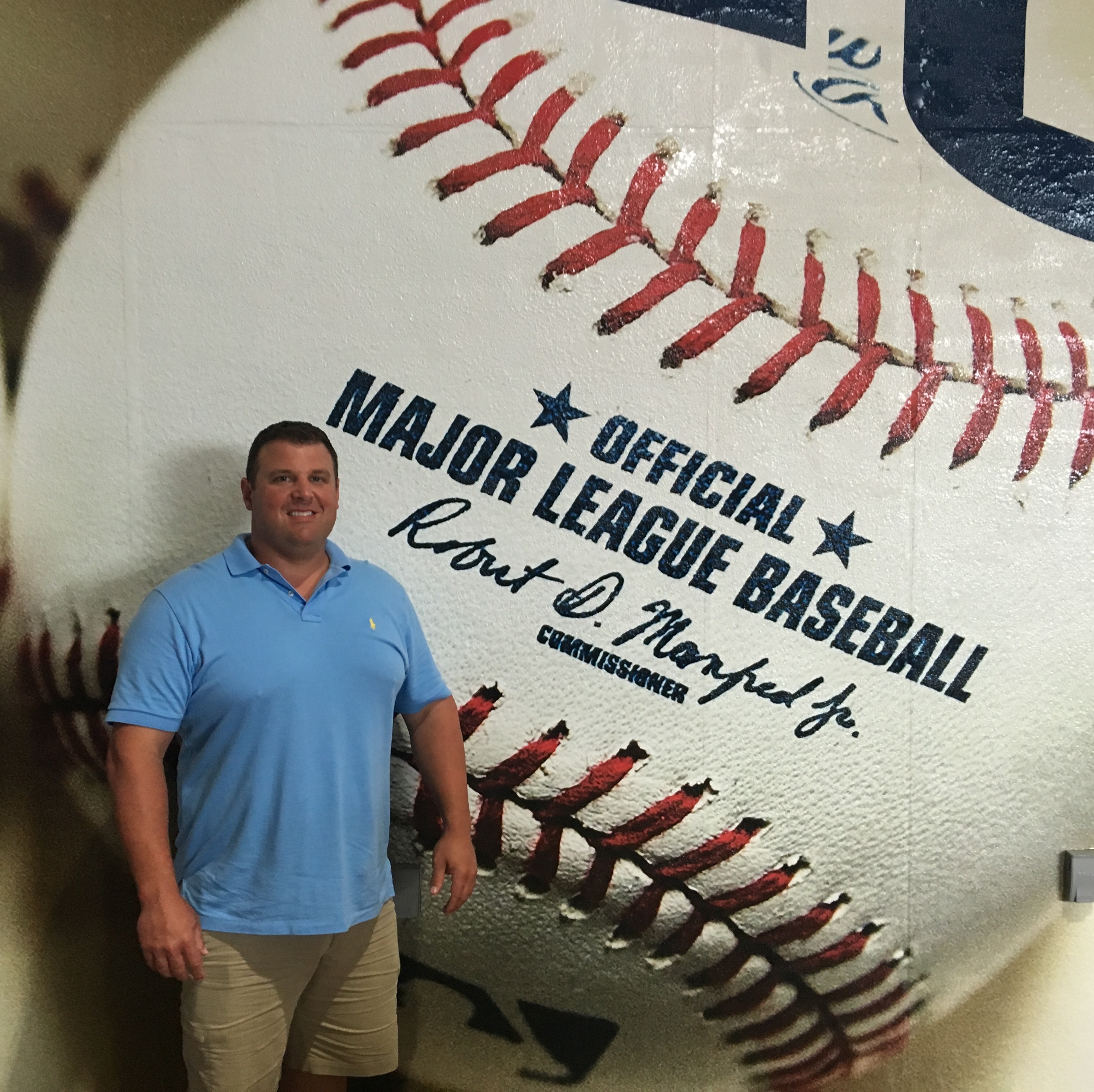
In 2017, Dr. Woolsey worked in conjunction with NxtGen sports as a sport psychology and talent development consultant, as well as with Major League Baseball (MLB) organizations to help them identify psychological factors that are important to improving player development and scouting programs.

As part of his consulting, Dr. Woolsey helps MLB organizations in the refinement of mental skills training programs and with improving evaluation methods. His focus is on the improvement of player development programs for existing players and the evaluation of future draft picks.
conradMLBIn professional baseball, perfectionism is a common personality trait that can develop into performance issues. In a sport where failure and criticism are large parts of the game, Dr. Woolsey aims to help players with the perfectionist personality profile develop a healthier, happier and more adaptive mindset. To do this, he uses a strength-based approach with an emphasis on teaching positive psychology techniques and by helping people make improvements to daily skills such as self-talk. As part of this process, players develop a motivational style focused on approaching challenges versus motivation based on avoiding failure.

One of the biggest misconceptions about the field of sport psychology is that mental performance consultants are just for athletes with performance issues. The reality is that sport and performance psychology is for improving and achieving optimal performance. Often those who seek additional help are already performing at the highest levels, but want to get even better.

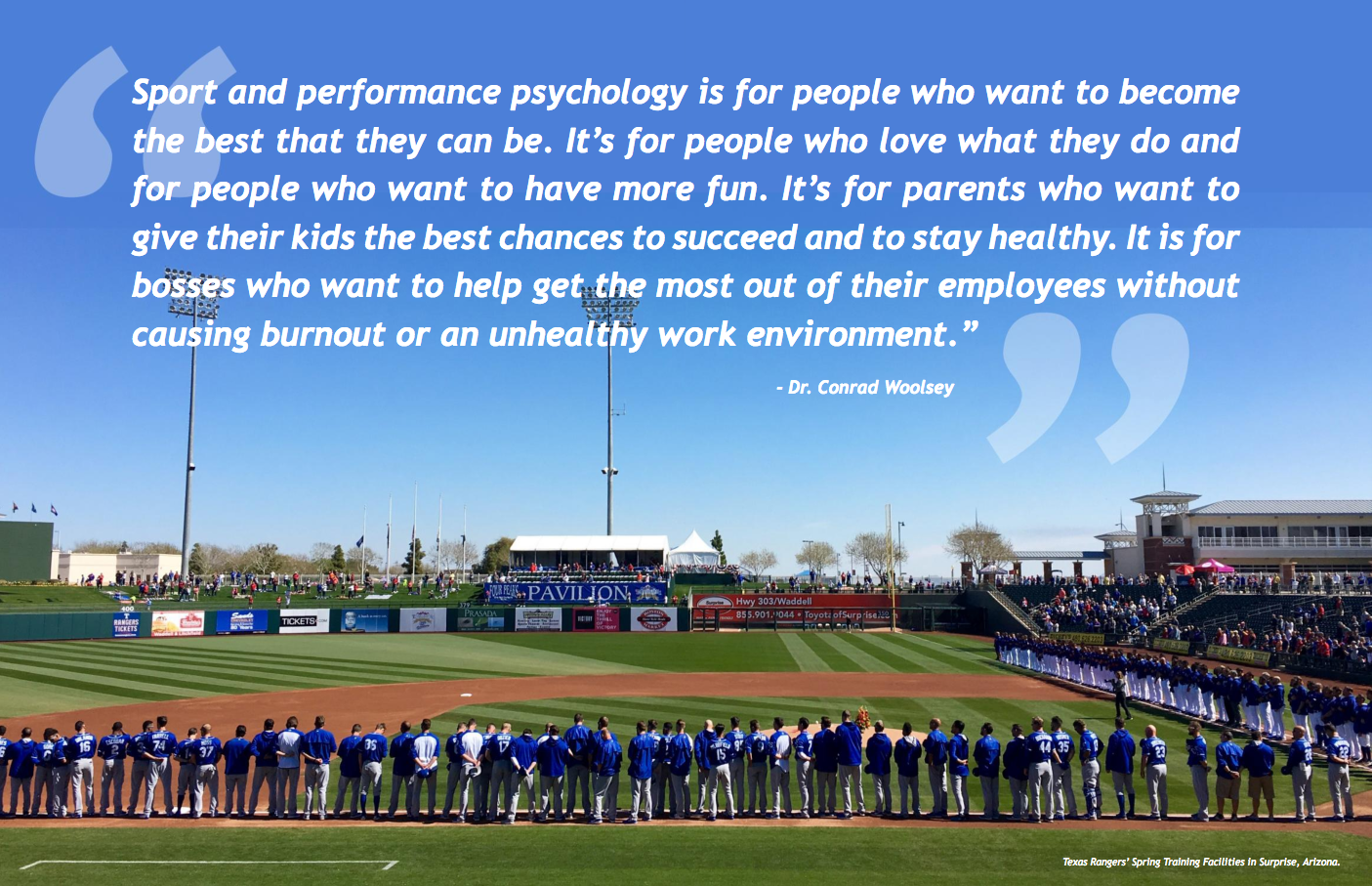
“Sport and performance psychology is for people who want to become the best that they can be,” explained Dr. Woolsey. “It’s for people who love what they do and for people who want to have more fun. It’s for parents who want to give their kids the best chances to succeed and to stay healthy. It is for bosses who want to help get the most out of their employees without causing burnout or an unhealthy work environment.”

An example of a profession that uses mental performance consultants for enhancing performance versus overcoming a specific problem is the military. Currently, the military and special forces are the biggest regular-employer of sport and performance consultants. Some of the main goals within these organizations are teaching skills such as stress management, relaxation techniques, concentration under extreme pressure, communication skills and effective coping mechanisms.

Dr. Woolsey was first motivated to study sport psychology because he wanted to maximize his own performance as a college athlete. He later became certified in sport psychology during his time as a college and professional coach because he wanted to be sure he was doing everything he could to help those he served to be successful.

“Growing up, I was lucky to have several good coaches, teachers and amazing family support, but also had my fair share of bad sport experiences,” he explained. “Living on both sides of sport and seeing the major impact that sport can have on kids (both positive and negative) is what initially inspired me to become a coach and a teacher. Having multiple surgeries, rehabbing to get back to top shape, and then having even more surgeries also had a big influence on why I got involved with the field of sport psychology. While injured, often the only thing I could do to get better was to work on skills such as visualization and training my mind. While my body became limited on what it could do, I could still get better by improving my mental skills.”

As director of the sport and performance psychology program at UWS, Dr. Woolsey has helped design the curriculum to prepare graduates with the first-hand experience needed to serve as leaders in sport, coaching, mental health counseling and wellness disciplines.

“At UWS, we are making a big difference by training leaders, coaches and parents by giving them the tools to effectively help others have meaningful sport and work experiences. The goal of our program is to train leaders of today and tomorrow to be even better at what they do and to help communities become healthier, happier and more successful.”

When asked the question, “what is the most important thing to keep in mind before beginning a career in sport psychology,” Dr. Woolsey stresses that one must enter the profession for the right reasons and be motivated by wanting to help others first and foremost.

“You have to be dedicated to learning all you can about people and what motivates them,” he explained. “This calls for skilled listeners and someone good at empathizing with others. Helping people is both an art and a science. In this field, those who have that as their intrinsic motivation will go far.”

To receive more info about the sport and performance psychology program and to connect with a UWS advisor, submit your contact information here.

conrad quote

UWS Golf Tournament

golfers in golf carts
The 2nd annual UWS student golf tournament sponsored by RockTape at Glendoveer Golf Course was a great success. Thank you to all of the participants, sponsors and donors! The tournament was organized by UWS sports council.The 9-hole scramble tournament winners were:
Nic Asla
Trinity Castner
Gene Mullen
Sean Nagasak
Sponsors:
RockTape
The Wooden ChickenDonors:
Target
Sports Clips
Golf Galaxy
KIND
KT tape
Saucy Beast Hot Sauce
Chipotle
Spinal Tap
golf tournament

UWS Running Club has Electric Finish in Annual Hood to Coast Relay

The Hood to Coast relay is a massive event with more than 1,000 teams. At 12 runners and two vans per team, that’s about 12,000 runners and 2,000 vans. The race begins at Timberline Lodge in Government Camp, Oregon and finishes in Seaside, Oregon, spanning 199 miles.

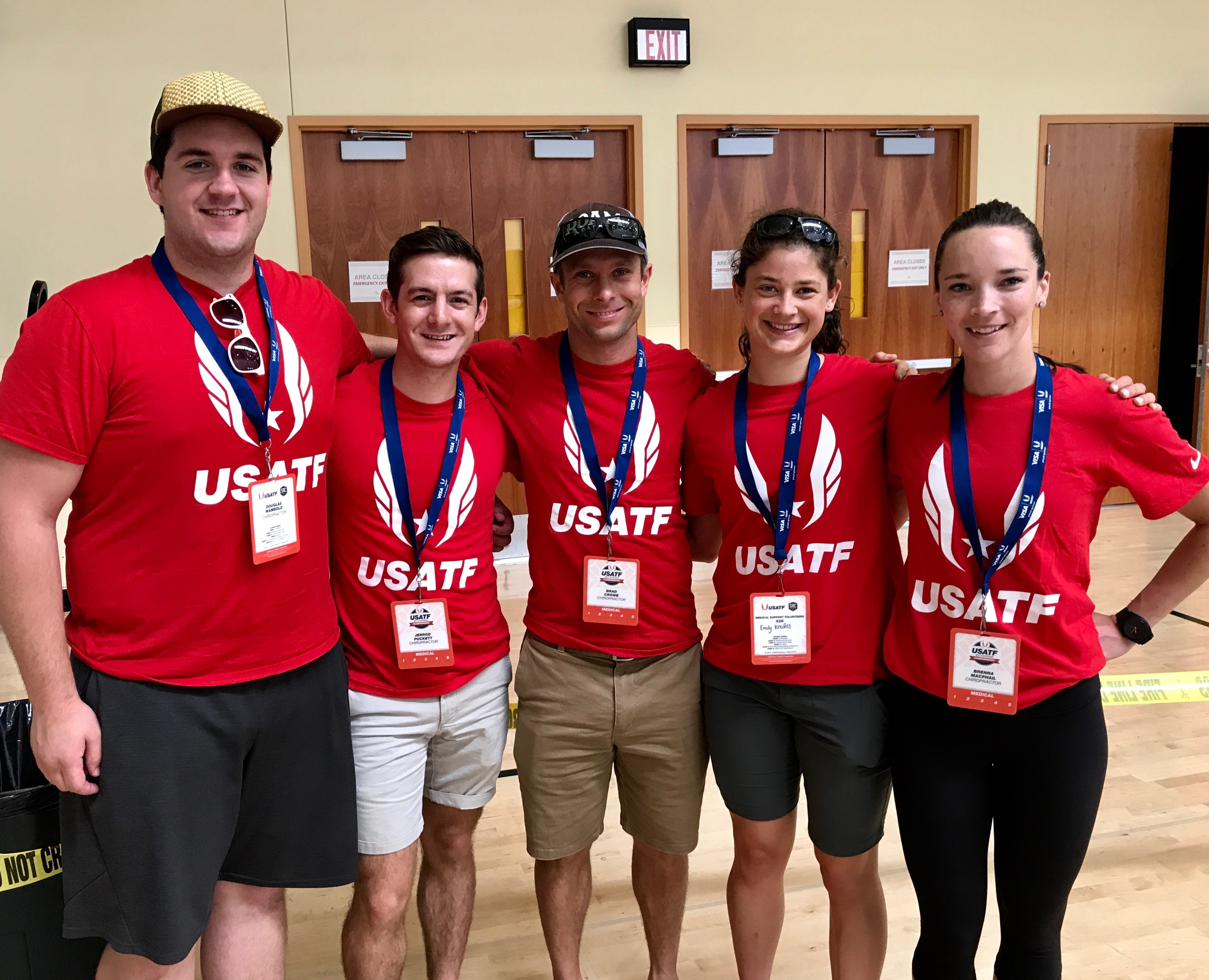
Bradley Crowe, University of Western States (UWS) 11th quarter doctor of chiropractic (DC) student, was one of 12 runners to represent UWS in the annual relay. The team took 10th out of 100 teams in their division. Crowe recaps the relay and the massive success of the participating UWS students and volunteers.

hoodtocoast2

Last year, I was in van one, so this year I was excited to be in van two and have the chance to experience the other half of the race. With an 11:45 a.m. start time, it meant that van two got to have a late start. We loaded up with food, sleeping bags and spare clothes and hit the road around 2:30 p.m. to head to Sandy, Oregon to meet the van one crew who kicked things off for the team. We were lucky enough to have Dr. Lester Partna, UWS associate professor, drive for this first section of the race. The drive out to Sandy was pretty normal, but as soon as we got to Sandy High School, it was chaotic. There were hundreds of people and vans everywhere with a loud speaker blaring out team names as they came into the transition area. Lots of vans were painted with creative team names such as “Hood to Toast and Eggs and Bacon,” “Gone with the Winded” and “Between a Walk and a Hard Pace.”

One of the hardest parts of the whole event is the waiting. The first runner from van two, Emily Kreifels, 7th quarter DC student, was ready to go, but we didn’t know exactly when our runner from the first leg would arrive. We managed to find some shade and waited as long as possible before braving the hot sun. Once the transition was made, things went pretty smoothly for the rest of the leg. The only downer was that we couldn’t get Dr. Partna’s running playlist to play!

I had the last leg of this section of the relay and the view was gorgeous. We ran along the Springwater Corridor all the way to Waterfront Park and then along the Esplanade to the Hawthorne Bridge. The start of the leg was during twilight and it quickly transitioned to pitch black. With no street lights along the trail, all I could see ahead of me was a train of little blinking red lights from the other runners. One of the best and most competitive elements of this race are “kills.” Most vans keep track of how many people each runner passes and then scores them as kills with hash marks on the side of the van. I managed to get 45 kills in this section, so I was pretty pleased.

We dropped off Dr. Partna and picked up Raquel Osborn, UWS student services coordinator, at around 9:30 p.m. After a quick pit stop for food and bathroom breaks, we blasted off to St. Helens for the next exchange. At least that was the plan…construction on I-84 meant that we were stuck in bumper-to-bumper traffic for 30 minutes. Oops! Eventually, it cleared and we made up good time to St. Helens. The exchange was at the fairgrounds, so there were hundreds of vans parked all over the place as well as designated sleeping areas in the fields. The seats in the van folded down to make a large flat area, so a few people threw down blankets and slept in the back of the van. Matt Boetcher, Q11 DC student, Kelsey Woodland, Q11 DC student and I grabbed some sleeping bags and headed out to the field. I checked in with van one and estimated they would be arriving at the exchange at 1:15 a.m., giving me just over an hour to rest. I closed my eyes, but was too wired to sleep. I got the call from van one that they were getting close, so I hopped up to get Emily ready. The site at the fairground was all pretty surreal. The massive crowds waiting, the loud speakers blaring incoming runners and hordes of people curled up in the fetal position just trying to get a few precious minutes of sleep. After waiting for what seemed an eternity, we finally made the exchange and were back on duty.

hoodtocoast5

The start of the race the following day can be as early as 5 a.m. and there are also teams that gather with the crowd participating in the Hood to Coast event. To begin, we were behind all of them on the small back country roads around St. Helens. Traffic moved alright, until it was about a mile to the transition zone. There, it turned into a crawl as everyone maneuvered to pickup and drop-off runners. As we sat a half mile from the exchange, I looked out the window just in time to see Emily running by. I leaped out and started running along with her – officially, the exchange can’t happen until the exchange-zone itself. Once I got the runner’s band in the designated area, I settled into a rhythm on the long and steep climb, but almost immediately got passed by another runner. He moved about 10 meters ahead. I slowly worked my way back and was able to overtake him halfway through the leg. For me, this little victory was one of the highlights of the race.

Once at the exchange, Matt took off for the hardest leg of the event. This leg consists of a long gravel section and due to last minute changes, the leg had gone from eight to 11 miles. Matt is not a runner, but I don’t know what it is about running at night…he becomes a monster! The transformation in Matt was my favorite part of the whole event! When he finished his leg, he radiated with excitement.

The next few legs of the relay followed the same pattern of getting stuck in traffic and a runner jumping out a half mile or so early to make the exchange. At around 6 a.m., we had reached the town of Mist, Oregon and cell reception was getting spotty. Fortunately, van one was there to meet us and was ready to roll. We cruised off to the final major van exchange near Olney. The only problem was that there was only one road in the area, so we were still stuck behind all of the traffic waiting for runners. Argh! Eventually, we made it to the exchange where breakfast was being served. Here, the team split up a little bit so that everyone could take care of their own needs. The back seats of the van went down again so that a few people could sleep. There was also a coffee hut and even a place that had bacon and eggs. This was probably the most stressful exchange, as we had no idea when the other van would show up and now there was no cell phone reception at all. However, we were equipped with little hand radios, so one person would wait up by the exchange so that they could radio back to the rest of the team when our van arrived. Looking at the map, we realized that the next leg was a short one, so we decided to leave early so that we could actually make it to the exchange zone before our runner.

There was a little more room at most of the exchanges now as the teams had become more spread out at this stage of the race. However, as time ticked on, the heat from the sun got brutal and there was hardly any shade on many parts of the course. We started stopping in the middle of the leg to check on our runner and pass them some much needed water. Finally, it came to me on the glory leg. Starting off near the top of the hill, I had a short climb followed by a long decent down to Seaside. Once I crested the hill, I could see all the way out to the ocean – definitely another highlight of the race. Finally, I hit the flats on the outskirts of Seaside and out to the Promenade. As I rounded the corner, they called out our name and van one ran out to join me as we crossed the line and finally finished our collective 199 miles.

The University of Western States team finished around 3:15 p.m. on Saturday with a finishing time of 27:22 placing us 10th in our category. After getting some team photos and sharing a few stories, it was time to hit the ocean. We collectively hobbled out to the water and only when it was too late did we realize how cold the ocean still was despite the heat of the day!

Huge thanks to UWS for supporting the team and special thank you to all of our van drivers and volunteers who so graciously donated their time so that we could participate in this big crazy adventure: Dr. Partna, Dr. Savannah Shortz, Mason McCloskey, Ross Robarge and Jeff Prause. Another special thank you to Raquel Osborn, who not only was key to organizing the event, but also volunteered to drive. Thank you so much!

To view a detailed map of the relay course the teams follow, visit the Hood to Coast website.

hoodtocoast4 hoodtocoast3  hoodtocoast1


Hood to Coast 2017

Good luck to the 2017 UWS Hood to Coast team!

  • Stephanie Beveridge, DC student, quarter 12
  • Matt Boetcher, DC student, quarter 11
  • Brad Crowe, DC student, quarter 11
  • Scott Kimbell, DC student, quarter 4
  • Emily Kreifels, DC students, quarter 7
  • Parker Pratt, DC student, quarter 8
  • Natasha Smith, DC student, quarter 12
  • Rachel Wysocki, teaching assistant
  • Kevin Yurkish, DC student, quarter 12

UWS Hood to Coast team!  UWS Hood to Coast team  UWS Hood to Coast team  UWS Hood to Coast team  UWS Hood to Coast team  UWS Hood to Coast team

OHSU Rotation and AIHM Fellowship

Beginning this fall, UWS chiropractic students will be able to complete a 10-12 week preceptorship during their final term within the Oregon Health and Science University’s (OHSU) Comprehensive Pain Center.

The OHSU Comprehensive Pain Center is an integrative care network for pain patients that consists of a variety of different providers, including allopathic anesthesiologists, nurse practitioners, clinical psychologists, acupuncturists, massage therapists, a physical therapist and a chiropractic physician. Currently, the chiropractic physician on staff is UWS alum Jordan Graeme, DC, MS.

Oregon Health and Sciences University
Photo courtesy of Oregon Health and Sciences University.

Through this collaborative relationship, UWS students will be under the direct supervision of Dr. Graeme during their preceptorship. These students will engage in integrated, team-based patient care and will also participate in observational rotations within other departments of the hospital. The program closely aligns with the model of rotations UWS students perform in Veterans Affairs (VA) hospitals.

“I appreciate OHSU for developing such a comprehensive, collaborative pain center, particularly in a traditional hospital setting,” Joseph Pfeifer, DC, UWS vice president of clinic affairs said. “This experience will be invaluable for our students. After obtaining the foundational knowledge and clinical skills at UWS, this rotation in an integrative environment at OHSU will enhance students’ competence and confidence in working with professionals of other disciplines to provide collaborative patient care.”

In addition to the OHSU rotation, UWS has partnered with the Academy of Integrative Health and Medicine (AIHM) through the Oregon Collaborative for Integrative Medicine (OCIM) to create a fellowship program for health care providers.

Through this fellowship, field practitioners gain knowledge of other healthcare disciplines through various coursework and receive firsthand exposure to patient care through observational clinic rotations. Providers in the fellowship program observe chiropractic care through the UWS clinic system, traditional medical care through OHSU, eastern medicine and acupuncture via the Oregon College of Oriental Medicine (OCOM), and naturopathic physician care at the National University of Natural Medicine (NUNM) in Portland.

Participants in this program come from a variety of disciplines from all over the country, as well as internationally, to learn through didactic material available online. The culmination of their coursework is a trip to Portland, where fellows participate in weeklong rotations between the participating schools and health care facilities.

“There is an inherent understanding and good evidence that having providers interact with one another to explore what is in the patient’s best interest improves the quality of care,” explained Dr. Pfeifer. “Providers gain an appreciation of each other’s role, and patients’ care and satisfaction benefit from a collaborative, coordinated team approach.”

“Both of these programs are consistent with our mission at UWS to advance integrative health care, and they reflect the type of training we aim to provide our students. We want our graduates to provide high-quality, integrative care, whether it be in a private office setting, a multidisciplinary group setting, or a hospital. Wherever they end up, they and their patients will benefit from their awareness of what other practitioners do, and they will help other providers gain insight and appreciation of the chiropractic profession.”

Free Concerts and Movies in the Park

concerts in the parks

UWS is proud to team up with Portland Parks and Recreation this summer for FREE concerts and movies in the park. UWS will have a booth set-up at multiple events throughout the summer. Grab some friends, stop by the UWS booth and enjoy free entertainment!

*All concerts and movies run from 6:30 – 8:15 p.m.

CONCERTS 

  • August 2 (Ventura) Artist: Chervona
  • August 7 (Berrydale) Artist: 3 Leg Torso
  • August 14 (Berrydale) Artist: Pete Krebs
  • August 16 (Ventura) Artist: Cedro Willie
  • August 21 (Berrydale) Artist: Inka Jam

MOVIES 

  • July 28 (Knott) Movie: Zootopia
  • August 4 (Village Square Parking Lot) Movie: Moana
  • August 14 (Wilkes) Movie: Miss Peregrine’s Home for Peculiar Children
Explore the full list of all the free events put on by the Parks Department here.