Free Services for our Veterans

The Northwest Center for Lifestyle and Functional Medicine and Returning Veterans Project partner to provide free chiropractic care and massage therapy to area veterans

The new UWS center is now the largest provider of services to the non-profit

For many, Memorial Day signifies the start of summer. It’s a holiday that kicks off the season of BBQs, beach excursions, family reunions and camping trips. It’s a day off from work to be celebrated with friends and family next to a grill, with cold lemonade in hand. But for veterans and military families, the day has a more poignant significance. It’s a holiday to remember friends, family members, neighbors and fellow Americans who were lost during military service.

As people across the nation are ramping up to celebrate the holiday, University of Western States (UWS) is proud to announce a new alliance between The Northwest Center for Lifestyle and Functional Medicine (NWCLFM), a new center of excellence at UWS and the Portland-based non-profit Returning Veterans Project. Through the partnership, Portland-area, post 9/11 war-zone veterans are eligible to receive free chiropractic care and therapeutic massage at the university’s outpatient campus clinic. The NWCLFM, in conjunction with UWS, is providing up to 28 hours of free therapeutic services per week to veterans, making it the largest provider of health services in the Returning Veterans Project network.

“What this signifies is that many Operation Iraqi Freedom (Iraq War) and Operation Enduring Freedom (Afghanistan war) veterans living with chronic pain, often due to the heavy equipment they had to carry for long hours, can now get services right away,” Belle Landau, executive director of Returning Vets Project said. “What we have found is that through services like massage and chiropractic care, vets get the help they need to get off their pain meds, stay in school, stay in their jobs, and hopefully become more open to counseling. These are life changing services that make family and work life easier for the people who served our country.”

Returning Veterans Project is one of the few veteran-centered health service providers that incorporates a holistic and integrative approach to treating the physical and mental scars of war. A number of studies support this method, showing that the biochemistry of a person after a massage demonstrates reduced cortisol and increased serotonin and dopamine.* Reports also show the importance of healing through chiropractic care. A study conducted on active duty military who received chiropractic care, along with conventional medical care for low back pain, showed a 73 percent decrease in acute pain versus the 17 percent in veterans who only participated in conventional medical care.**

“I am so excited to team up with Returning Veterans Project. This provides UWS massage students an excellent opportunity to work on a population that can really benefit from massage. Not only will it provide help for the physical ailments associated with combat, but evidence also shows the value massage therapy has for people suffering from PTSD, anxiety and depression,” Eric Polgar, director of the UWS massage therapy program said.

“Offering our service men and women free therapeutic services is our way of saying ‘thank you’ to a group that risked their lives for our country. I am so grateful to be a part of this opportunity and I know our students and the veterans will benefit from this partnership,” Dr. Stan Ewald, associate vice president of clinical internships and assessment added.

Appointments are available starting May 26.


UWS student, Freya Moran, selected as first chiropractic participant in the LEAPS into Integrative Medicine program

This is the first year the integrative medicine program is open to non-MD/DO students

PORTLAND, Ore., May 13, 2015 – University of Western States (UWS), a leader in the education of health care professionals, is proud to announce that doctor of chiropractic (DC) student Freya Moran was chosen to attend the Leadership & Education Program for Students in Integrative Medicine (LEAPS in IM). The program, a week-long event hosted by the Academic Consortium for Integrative Medicine and Health and the American Medical Student Association (AMSA) Foundation, aims to enhance the leadership skills and knowledge of future integrative medicine practitioners.

Moran, a 7th quarter student from Michigan, was chosen based on her proposal outlining an integrated medicine residency program for DC students.

“For too long there has been this curtain up in front of chiropractic but times are changing and there is a desire in more and more chiropractic students to be part of an integrated medical team after graduation,” Moran said. “I want to help take this curtain down. I think with this extended residency idea there will be more opportunities for chiropractors to learn how to talk to MDs and other practitioners on an integrated health care team in their language.”

Moran will be attending the program in Old Mission San Luis Rey in Oceanside, Calif., June 14-19. The program is limited to 30 students. As part of acceptance into the program, Moran is required to plan and execute her proposed idea of an integrated health care chiropractic residency with support from her faculty mentor and core faculty at LEAPS. As part of the program, she will be meeting with mentors to refine her concept.

Gary Schultz, DC, DACBR is one of the faculty members mentoring Moran in the process.

“The successful integration of health care resources begins with relationship building and sharing patients’ care needs between professions,” said Dr. Schultz. “This program and Ms. Moran’s ideas are a great step in accomplishing this goal. I’m pleased and humbled to be allowed to work with her on this journey.”


Oregon Passes Non-Discrimination Bill

UWS alumni, Vern Saboe, DC, recently wrote a news release for the American Chiropractic Association (ACA) highlighting a big win for the chiropractic profession in Oregon. A bill was passed that adds the federal non-discrimination protocols in the Affordable Health Care Act into Oregon state law. Oregon became the first state to adopt these protocols.

April 30, Salem, Ore., House Bill 2468 passed off the Oregon Senate floor on a 30-yes, 0-no vote and in so doing inserts the federal Section 2706(a) from the PPACA (ObamaCare) into state law, says Dr. Vern Saboe, ACA Delegate and lobbyist for the Oregon Chiropractic Association. The bill represented nearly a year of work and political negotiating however, key to our success was the help the profession gained from former Governor John Kitzhaber, MD, Saboe said.

In 2012 Governor Kitzhaber at the profession’s asking, inserted 2706 into his Senate Bill 1580 which dealt with “Coordinated Care Organizations” (CCOs) pertaining to the Medicaid and Medicare populations, CCOs are Oregon’s version of a federal Accountable Care Organization (ACO). The profession again gained key help from Governor Kitzhaber who met behind the scenes with the Oregon Insurance Commissioner stressing the importance of 2706 being inserted in Oregon law. Subsequent to that meeting the commissioner inserted 2706 into the Oregon Insurance Division’s draft legislation which became HB-2468. Dr. Saboe has requested a signing ceremony with the current Governor Kate Brown and OCA officials.

Antibiotic Use in Food Animals – How this Practice Affects Everyone

By Rachel Fischer, MD, MPH, Integrative Therapeutics distinguished professor

On April 6, 2015, the Oregon Senate Committee on Health Care heard testimony from a number of concerned citizens and organizations regarding a bill that seeks to limit the non-therapeutic use of antibiotics in Oregon livestock and poultry. Because of my previous involvement in this issue through Health Care Without Harm, I was one of several people giving testimony in favor of Senate Bill 920 — Relating to protecting antibiotics for human public health; declaring an emergency.

Essentially, this bill:

  • Prohibits giving antibiotics to healthy farm animals in Oregon. The measure has exceptions for when there is a significant need to control an outbreak.
  • Requires disclosure of how antibiotics are used on factory farms. The bill will require EPA-defined Concentrated Animal Feeding Operations (CAFOs) to annually disclose the details of their antibiotic use and make that information public record.

Why is this law necessary?

Organ transplant, chemotherapy and common surgical procedures like a cesarean section and appendectomy – these are just a few of the medical treatments that would no longer be safe without the use of antibiotics. The problem is that resistance to every antibiotic we use is growing. According to Dr. Tom Frieden, director of the CDC, “antimicrobial resistance is happening in every community, in every health care facility, and in medical practices throughout the country. At least two million people per year in the U.S. get infections that are resistant to antibiotics, and 23,000 die.” And considering that drug makers developed about 20 new classes of antibiotics between 1940 and 1962, but only two new classes since then, our arsenal is diminishing.

Most physicians and patients recognize that antibiotics are over prescribed. The Centers for Disease Control and Prevention estimate that this is true up to 50 percent of the time. However, even if prescribing practices by providers and antibiotic use by patients was perfect, the issue of growing antibiotic resistance would not be solved.

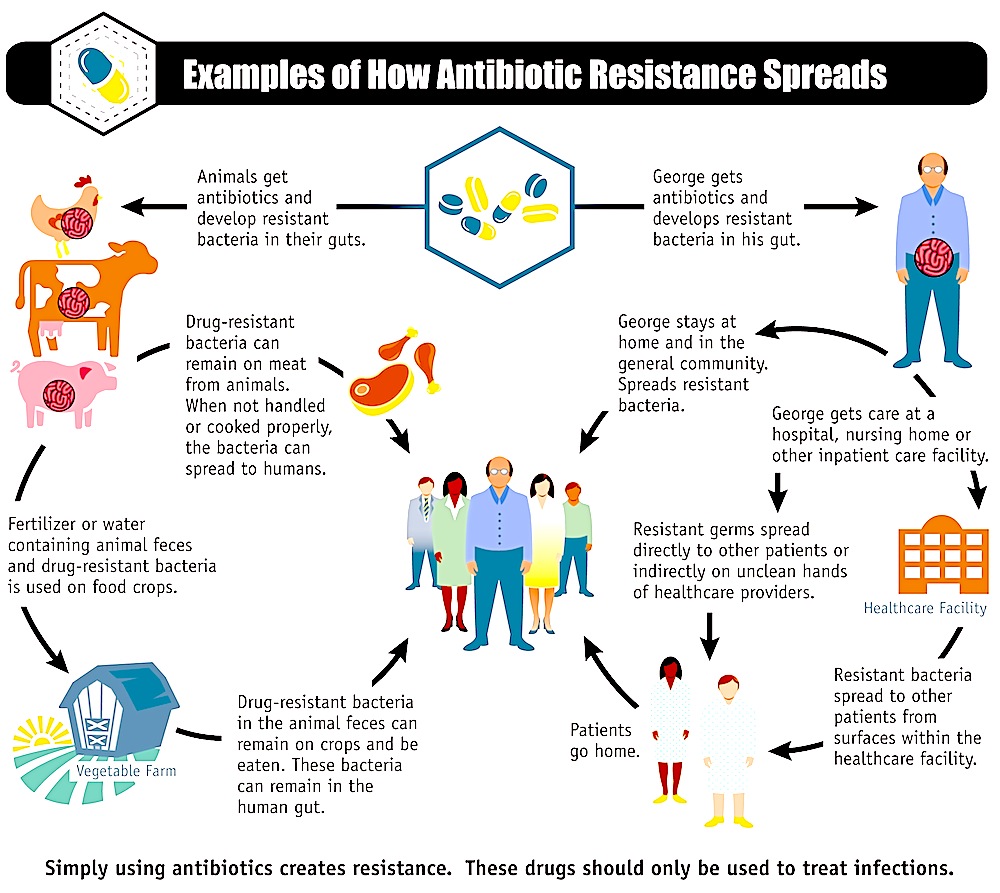
An estimated 80 percent of antibiotics sold in the U.S. are for food animal production. Many classes of the antibiotics used for this purpose are also medically important for treating human disease. Most of our meat comes from CAFOs where animals are housed in very tight and unsanitary quarters which creates an ideal bacterial breeding ground. Of course, antibiotics are given to sick animals, but an equally common practice is to routinely give subtherapeutic doses of antibiotics for growth promotion and to prevent infection. In this scenario, antibiotics seem necessary to maintain our food supply. However, even if that were true, it ignores the perhaps more catastrophic consequences of continuing on the current path of antibiotic use.

One of the reasons bacteria are so resilient (they have, after all, essentially existed on earth since the beginning of time) is that they can easily exchange genetic material with or without breeding. That means a perfectly harmless bacterium species can develop antibiotic resistance and pass that resistance on to a more virulent, harmful species. When millions of food animals receive subtherapeutic antibiotics every day, one can only imagine the downstream effects:

  • Bacteria carrying resistance genes outlive those without resistance and continue to multiply;
  • Resistance genes are passed among bacteria living in the surrounding soil, in the animals and on the farm workers;
  • Farm workers inadvertently share their bacteria with their families and communities;
  • Food animals are transported on our highways when it’s time for slaughter, literally “spraying” bacteria in their path;
  • Animal waste from CAFOs is used to fertilize crops, further spreading bacteria carrying resistance genes – even to those who never consume meat; and
  • Mature crops carrying antibiotic resistant bacteria are sold directly to markets and for packaged food production.

During 2010 Congressional testimony, the FDA, USDA and CDC reported there is a definitive link between routine, non-therapeutic use of antibiotics in food animal production and the antibiotic resistance crisis in humans. And there is another often overlooked consequence of this practice that we are just beginning to comprehend – how environmentally pervasive antibiotics and resistance genes affect the human microbiome.

The human body is composed of about 30 trillion human cells, but is host to more than 100 trillion bacterial and fungal cells. Our bacteria and their DNA play a fundamental, essential role in human health. Antibiotics significantly impact our microbial diversity and have been linked to chronic diseases such as obesity. In his book, “Missing Microbes,” Dr. Martin Blaser states that our bodies are an ecosystem “much like a coral reef or tropical jungle, a complex organization composed of interacting life forms. As with all ecosystems, diversity is critical …. High diversity affords protection to all species within the ecosystem because their interactions create robust webs for capturing and circulating resources. Loss of diversity [can lead] to disease or collapse of the system.”

While some say it is not economically feasible to limit antibiotic use in order to maintain our food supply, experts agree it will likely be economically catastrophic in unmeasurable ways if we do not take steps to stop the non-therapeutic use of antibiotics in all forms. Dr. Blaser cites game theory and the “Nash Equilibrium” to shed light on the phenomenon of cooperation in regards to our relationship with bacteria, “It can be summarized as a strategy in a game with two or more players in which the outcome is optimized by playing within the rules; if you cheat, your outcome is worse than if you played fair and square.” Allowing unchecked use of antibiotics is cheating the game.

To email your local representative and the governor, readers can go to the Oregon State Public Interest Research Group website: Take Action with OSPIRG

UPDATE:

SB 920 passed the Senate Health Care Committee and went to the Rules Committee. Unfortunately, no action was taken by the Rules Committee before the 2015 legislative session ended.  Antibiotics is a major issue and a repeat bill will likely appear next year.  No other state has passed legislation restricting non-medical use of antibiotics in food animals.  This may be a long fight, but the evidence continues to build in favor of such measures. Plus, Obama recently released his federal action plan to combat the growth of antibiotic resistant bacteria.

Want to learn more, read the OSPIRG fact sheet!

National Summary Data, Antibiotic Resistance

UWS Launches Northwest Center for Lifestyle and Functional Medicine

New center focuses on promoting healthy behaviors and positive lifestyle changes

PORTLAND, Ore., Feb. 24, 2015 – University of Western States (UWS), an independent health sciences university founded in 1904, has launched a new center of excellence to promote healthy behaviors and positive lifestyle changes. The Northwest Center for Lifestyle and Functional Medicine aim is to educate health professionals, support community outreach, and conduct research in the areas of lifestyle medicine, health promotion, functional medicine, diet and nutrition. The center will target efforts on the UWS campus community, the Portland-metro area and the Pacific Northwest region.

National data trends indicate there is a growing need for solutions to address the escalating emergence of lifestyle-related diseases:

  • Obesity has increased 153 percent since 1990,
  • 23.5 percent of U.S. adults are physically inactive, and
  • 9.6 percent of Americans have been diagnosed with diabetes.*

“In our work, we see the growing link between chronic diseases and detrimental lifestyle choices, such as lack of exercise, alcohol and tobacco abuse and an unhealthy diet,” Dr. Joseph Brimhall, UWS president said. “We believe with an integrated and conservative approach, we can help people enjoy a higher quality of life. We want a significant part of this center to focus on serving our neighbors and our community.”

The center will host a number of activities that will support the Portland community including:

  • Healthy Lifestyle Lecture Series. The Healthy Lifestyle Lecture Series will provide free public lectures on healthy lifestyle practices, diet and nutrition, functional medicine, and integrative health care. Lectures will be held on campus and in the community. More information about the lecture series can be found here.
  • Mindfulness Program. UWS offers mindfulness programs for students and employees. Mind-body medicine elective classes explore a variety of meditative practices, including mindful eating and guided meditation. Weekly meditation sessions on campus are open to all. A course in mind-body practices will be available for members of the community to learn mindful/meditation practices and to improve their overall health

The center will focus on an integrated approach to medicine incorporating methods and practices from chiropractic physicians, massage therapists, diet and nutrition professionals, functional medicine specialists, mindfulness experts, exercise and fitness professionals.

“The Northwest Center for Lifestyle and Functional Medicine allows University of Western States to share its passion for preventive and lifestyle medicine with our community. It will also introduce a method of care that seeks to improve function and health across the lifespan while enabling individuals to learn how to take better care of their own personal health,” said Dr. Will Evans, provost and executive vice president of UWS.

*(2014, America’s Health Rankings: A call to action for individuals and their communities. United Health Foundation.)


About the Northwest Center for Lifestyle and Functional Medicine

The Northwest Center for Lifestyle and Functional Medicine was launched in 2015 as a center of excellence highlighting ways to reduce lifestyle-related health conditions such as diabetes, obesity and hypertension. The center’s vision is to promote healthy behaviors and positive lifestyle changes in order to achieve optimal quality of life for the members of our community through service, education and research. The center believes in integrated, conservative, patient-centered approaches to address lifestyle-related health conditions. To learn more about the center visit uws.edu/nwclfm.

Three key elements for sticking to an exercise program

By: Pamela Verhulst, ESS Adjunct Professor

  1. Set realistic goals

Many people starting a new exercise program set goals too high, leading to injury or illness. If goals are set too high and there is a setback, many do not return to their second workout. For example, if you are a novice, don’t plan on running a marathon in a month. Instead, focus on making small, incremental improvements.

  1. Be consistent

Consistency is key to sticking to your exercise program. If your schedule allows you to work out three days per week, stick to it. In order to stay consistent, review goal #1 and set realistic times so you do not fail at following through. Don’t try to overreach and work out every day if you know it’s not sustainable. Only set your workout days to a schedule you can stick to.

  1. Have fun!

Keep your workouts fun. If you hate to exercise, you will dread every moment of           it, leading to frustration and quitting. Movement is exercise; choose moving the way you want to and have fun doing it. Heart raising activities you find enjoyable will help you stick to your exercise plan; choosing a tough workout that you dread will not. A fun workout will keep you coming back!