The Value of Generational Mentoring and Giving

Dr. Mike Pettet & Danielle Pettet
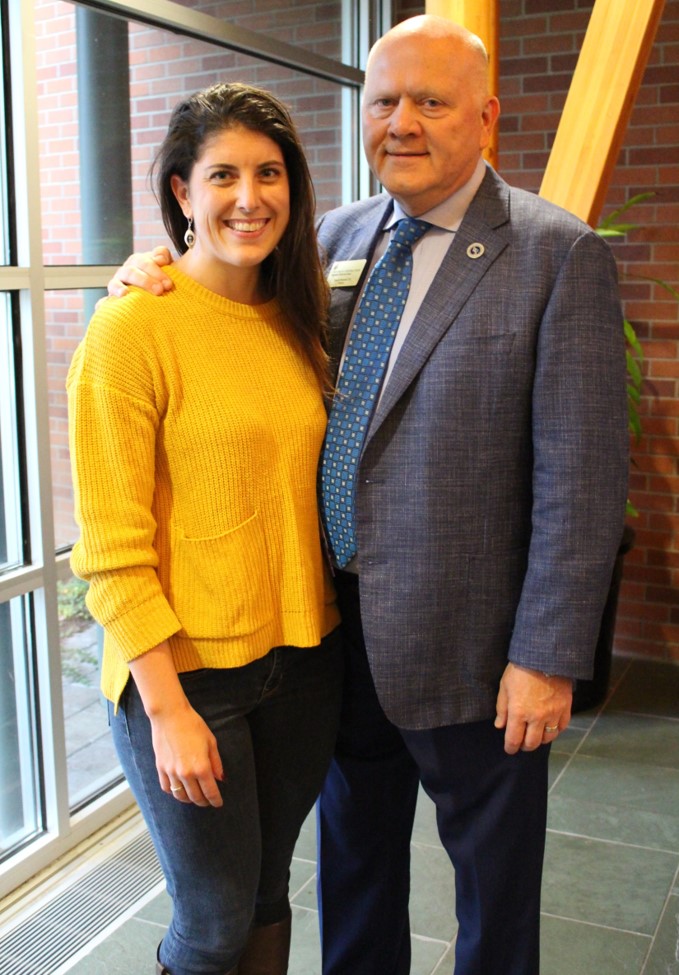
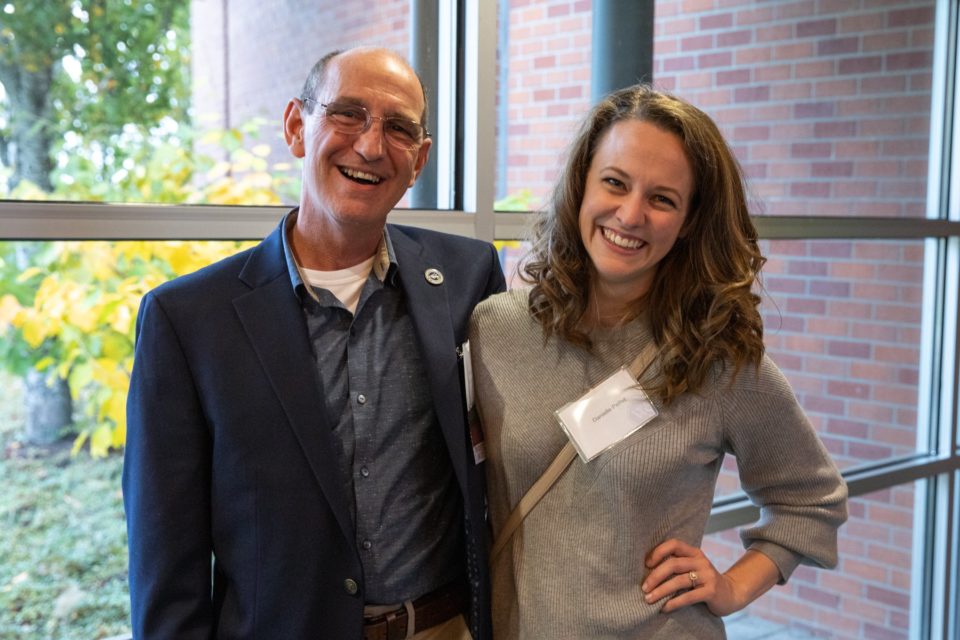
UWS board member and alumnus Dr. Mike Pettet (class of 2001) and his daughter and current doctor of chiropractic student, Danielle Pettet

Charitable giving, volunteering and giving back through mentorship are often values passed down from generation to generation. In the spirit of exploring how giving permeates throughout the family, we sat down for a Q&A with current doctor of chiropractic student, Danielle Pettet, and her father, current UWS board member, naming opportunity donor and alumnus, Dr. Michael Pettet.


Dr. Michael Pettet

Tell us a little more about the positive mentorship experiences you have had with UWS students.

The best experiences I have had while mentoring UWS students were when I had to stretch my knowledge, dust off a few cobwebs to answer a question, or research and learn a bit of new knowledge for myself. The second-best experience is watching a senior student or new associate gain experience and confidence. To see that glimmer of an “aha” moment in their eyes as the pieces fall into place in the real world is what it’s all about.

I make it a point to ensure that the students have a clear understanding of practice management and finances. Too often, new doctors are pulled into contracts with big promises that they can’t afford. UWS offers a free mentor network (Switchboard) that you should take advantage of, just reach out.

We need to be life-long learners and should want to pass that desire on to everyone we come in contact with. We may be considered experts, but you don’t know everything. A mentorship helps keep you up-to-date and keeps the humility real.

Why do you think it’s important for the previous generation of chiropractic physicians to mentor the upcoming generations?

I came to chiropractic after a 22-year career in the U.S. Marines Corps. Mentoring is in my blood (and yes, I was a drill instructor). Through the ranks, you are expected to train those below you and learn from those above. I strive to continue that mindset in this career. We are an evolving profession that has the potential to sit at all of the big tables of health care. To do that, we must share our own experiences, warts and all, with the next generation so that they can do better and go farther than we have.

The word mentor can have a lot of meanings: coach, advisor, counselor, teacher, instructor and more. The biggest benefit is having someone the mentee can meet with to ask questions, be a sounding board, help sort out options and give advice on practice and business matters. Mentoring is a one-on-one relationship where you have the opportunity to provide guidance to someone that could benefit from your experience. 

What would you say to encourage other donors to make an impact such as you and your family did?

I give back to UWS and the profession that gave me the opportunity to be successful and help people as a thank you.

I want to see UWS grow in stature by helping support the next generation of students and alumni. The donation may be earmarked for research, scholarships or improved facilities.

Most graduates give back in proportion to their own gratitude and success. If you fall into the “I already gave enough with my tuition” category, go back and review the mentor comments above or reach out to me and let’s talk about how to be more successful.

What are you most excited about for the new UWS campus?

Everything! The location, design, learning spaces, laboratories, meeting rooms, study settings and don’t forget modern health care facility.


Danielle Pettet

Were you inspired by your father growing up to pursue an educational path in chiropractic medicine?

To be honest, I was actually more inspired by my mom’s theatre background growing up, so I have an undergraduate degree in theatre arts! It wasn’t until I was pregnant with my daughter that I realized just how life changing chiropractic care can be for a patient. After my daughter was born, I had an opportunity to work for my dad as his office manager and saw first had the impact he had on his patient’s quality of life. I was inspired by his ability to make connections with patients from all backgrounds, and provide them with the help they needed to feel better, and get back to doing the things they loved.

Upon graduation, what are your goals as a chiropractic physician?

After graduation, one of my goals is to make a positive impact on my community by educating patients about the benefits of chiropractic care. My other goal is to continue to be a mentor to chiropractic students, in addition to new docs, through the university’s mentor program. I consider myself extremely lucky to have access to so many mentors in this profession, it would be great to have a chance to return the favor.

With your parents being great examples in philanthropy and charitable giving, how do you envision yourself, your peers and others giving back to the next generations? Should that be an area past and future grads should be reminded of in terms of their alma mater?

My parents certainly set the bar high, and they have instilled in my sisters and I the importance of giving back however you can. Whether past and future grads choose to make a charitable donation or to donate their time to mentor an up-and-coming chiropractic student, the next generation benefits. The thing I love most about this school is that no matter what quarter you’re in, everyone is so supportive of one another; it just makes sense to continue lifting one another up after graduation.

Spring Term DC Student Blog No. 6

A Look Back at Spring Quarter

By: Caitlin Jones, Q7 UWS doctor of chiropractic and sports medicine student

gardening

The Spring 2020 quarter was unlike any previous quarter I have ever had, even though I have taken online classes before. This was similar to previous doctor of chiropractic (DC) program quarters in that you’re constantly wondering how three months can seem like two days and five years all at the same time. It somehow goes by so fast, but it also feels like it just started. It was stressful, which is the norm, but a different kind of stress. One that was filled with constant change and having to adjust. These changes weren’t just school-related either.  Travel was cancelled, hiking trails were closed, and most of my friends and both of my roommates went home for the entirety. 

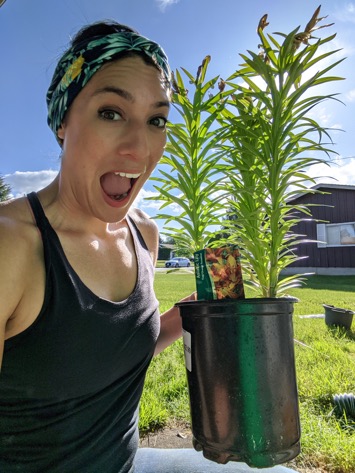
It was a lonely few months and I’m so thankful that I had school to keep me busy! Though there were a few weeks that it was a bit too busy. Thankfully, our professors were really responsive when they heard how crazy it was for us between the busy work and school load, so many adjusted their assignments to help. One week, a professor even told us that our assignment was to watch a five-minute video and go outside and enjoy the day. I literally cried I was so thankful. Acts like that truly saved my mental health as I was able to spend more time taking care of myself and picked up gardening, baking the quarantine banana nut bread, and going on a bazillion walks about the neighborhood – even walking by the old campus to make it feel a little more normal!  Though I definitely had days where I really struggled, the activities that I picked up really helped me re-discover my passions and I’m in a better place mentally that I have been for the past year.

As I mentioned, I’ve taken online classes before and rarely got anything out of them in the past.  It was always formatted to read something and then take a quiz.  Although I don’t know if I would say that my knowledge on the material is what it would have been if we had class as normal, our professors are proficient in online lectures and making it interactive when needed.  Even better, some professors are really slow talkers so that a 45-minute lecture can be watched in under 30 minutes!  The hands-on portion was really tough, and I’m so thankful that we have a review the first week of next quarter.  I know that our professors are going to do their best to get us up to speed as quickly as possible. 

Though this quarter was extremely challenging and required everyone to shift their previous ways of thinking and doing, I’m really grateful for our professors that were with us every step of the way.

Woodworking as a Treatment for a Traumatic Brain Injury

After suffering a TBI following a car accident, Leah Dash has found therapeutic relief mixing creativity and anatomy-inspired woodworking

By: Leah Dash, UWS doctor of chiropractic student


woodworking collage

As with any college student, I’m always coming across things on Facebook that I can’t afford (thanks, advertising people). More than once have I seen something and then tried my hand at making my own version. However, these have always been small crafts like pennants, embroidery projects, etc. I have always enjoyed exploring different crafts, but it became even more important after I suffered a traumatic brain injury (TBI) in a car accident in July 2018. Doing small focused and detailed tasks is actually therapy for my brain. I am still in occupational therapy but things like this are helpful in managing my symptoms.

So, in January, when I saw a posting for a “Rustic Barnwood Atlas Vertebra” for $300, I was immediately in love. Rustic? Barnwood? That’s basically everyone’s interior design scheme right now. And anatomy? Spine related? I had to have it. However, that price tag… for what is essentially recycled wood, I couldn’t justify.

Where does anyone our age go when they need to learn a new skill (aside from chiro school)? YouTube.

I fell down the proverbial hole of YouTube. I watched every video I could find on how to cut basic wood shapes and figured I had to try to make one for myself. Finally, ready to start doing instead of watching, I went out and bought a jigsaw and started practicing. The first few were obviously terrible, but I slowly started to get the hang of it. At this point I also realized I was using the wrong tool and then purchased a used scroll saw off Facebook marketplace. I know I’d mentioned cost above and at this point it was at about $100 for both tools.

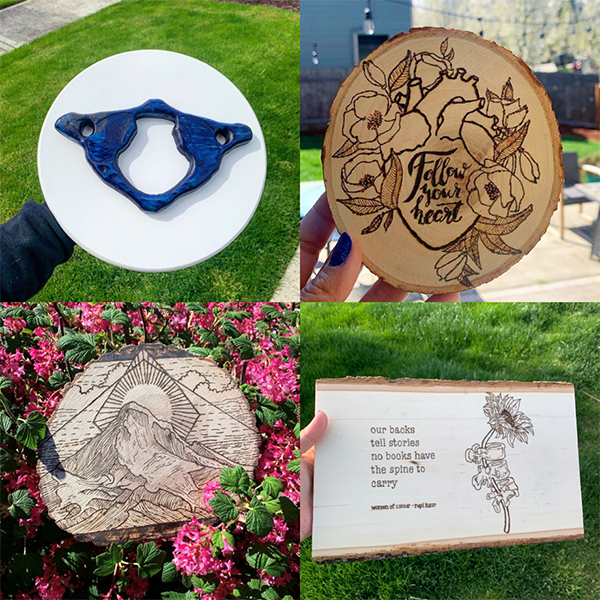
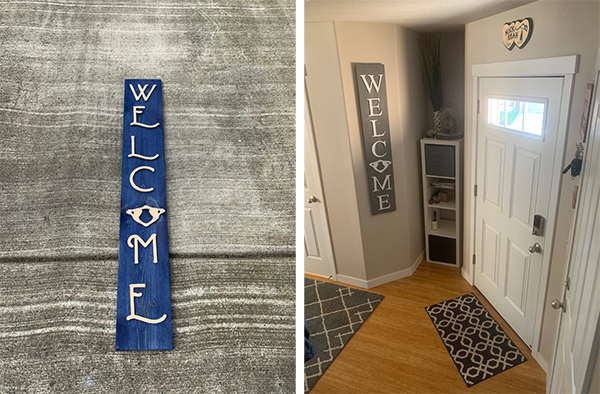
Inspired by some signs I saw on Pinterest and emboldened by my practice cuts, I decided to make a “Welcome” sign with the O replaced by an Atlas. This first attempt at lettering was pretty large, which is actually easier than making small cuts and was only a little wiggly, but let’s just call it “rustic,” ok? I then posted it on my Instagram and was surprised to receive a lot of attention from friends and local doctors. That was when I decided to sell a few to help offset the cost and make sure that I didn’t start hoarding wood vertebra.

woodworking

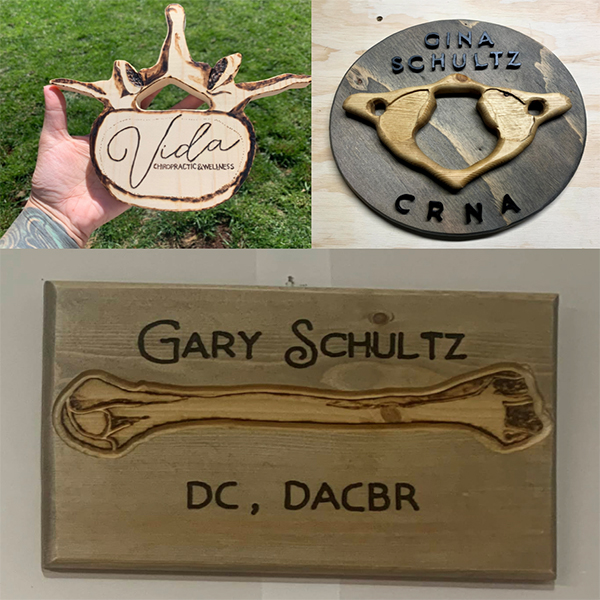
Most of what I make is anatomy based and I definitely consider the scroll saw to be my favorite tool. However, I also do a lot of pyrography, which is a woodburning technique that uses a heated pen to burn designs into wood. Obviously working on anatomy inspired pieces not only helps to improve my general knowledge (especially in Bone Path and other radiography courses), but it helps with my visual perception issues, such as perceiving a 3D object in space. I also have some issues with convergence and accommodation leftover by my TBI that are also helped by this “exercise” of focusing on the outline of my project on the scroll saw.  

I’m also very thankful because when my fiancé lost his job at the beginning of quarantine, focusing on these projects, as well as the small amount of revenue, helped offset my anxiety and our grocery bills. I’m also very proud because he managed to get another job a week ago, despite the current economic crisis, so we’re on much firmer footing now. However, I have continued woodworking each week throughout the term and plan to continue in the future.

In my future practice, I hope to be able to display a lot of cute chiropractic things throughout the office, especially one of my Welcome signs. I also really love giving them as gifts to friends, so I hope to continue to be able to do that as well, as long as people don’t get sick of handmade gifts.

If anyone is interested in buying one of my signs or requesting a custom piece please follow my Instagram @spine.tree or you can email me [email protected]. Just please keep in mind that my student schedule is pretty crazy and these things take time.

Speaking of crazy schedules, if you have a hobby that you want to work on and feel like you don’t have time- it’s something that you just have to set time aside for. Just like the emphasis we place on physical health and the importance of movement; we need to remember that mental health is just as important.  In my case, my brain firmly puts its foot down when it needs a break from studying but there are so many other signs from your body telling you that you need to go out there and do something that makes your heart happy. Also, if anyone wants to get into woodworking/woodburning let me know! I’m happy to help anyone on their crazy sawdust journey.

woodworking

UWS Stands in Solidarity

University of Western States

We express our extreme sadness and outrage over the senseless killing of George Floyd in Minneapolis. Our hearts grow heavier as we recall the names of the other friends, family, neighbors and community members whose lives have been cut short by racial violence. We try to fathom the immense heartbreak and despair that their families are enduring, as we commit to the dedication of justice for all.

As a university dedicated to improving the health and well-being of society, we have an obligation to engage in an honest evaluation of where we are, to plan for where we want to be, and to take action to create a just and equitable world.

This is a time when we must not only reaffirm our university core values of inclusiveness and equity—we must also take constructive actions to validate our commitment to embracing people from all backgrounds, beliefs, lifestyles and races. We stand united in our solemn support of our black students, our black patients, and our black alumni and friends. We affirm our ongoing commitment to the work of educating for justice. 

We must speak out against this hatred and bias, the gross injustices, and the structural racism that have plagued our society for far too long. We all have a duty to call for profound change, to end this systemic discrimination, and to create a community of inclusion and safety for everyone. 

This is both an intellectual and a moral calling. As members of the UWS community, we urge everyone to join in making these changes a reality. It will take our collective steadfast commitment, directed effort and invested time. It is often uncomfortable to confront the ugliness of racism and bias. There is not an easy way to make this cultural shift, and it is our responsibility to make it happen—on our campus, and in the world.

We stand in solidarity with our black students and all people of color in the UWS community and around the world. We invite you to stand with us. 

Together, we will make a difference.

In solidarity,

University of Western States

Administration, Faculty, Staff, Students, Alumni, Friends, and Trustees

Learn more about the University’s equity and inclusion task force and initiatives.
 

Investment in Equity: Cultural Innovation at UWS

In early 2018, University of Western States formed an equity task force with faculty and staff, and the effort is supported by new clubs such as ENGAGE (Ending Negative Generalizations and Growing Equality), the first-ever Pacific Northwest chapter of the Student American Black Chiropractic Association (SABCA), and the growth of the UWS Allies Club.

CEI logo

As the U.S. population becomes more racially and ethnically diverse, UWS is taking steps to ensure that the university fosters a culture of inclusivity and that curricula supports cultural competence as a key student learning outcome. These steps are an important way to minimize racial health disparities in the communities that UWS students and alumni serve.

“As health care providers and educators, we share a duty to promote cultural competence in health care education, to expand access for integrated health care services, and to increase educational and professional development opportunities for students from diverse and underserved communities,” said UWS President Joseph Brimhall, DC. “We are proud to deepen our commitment to creating an open and inclusive community for our students and employees, so that we are best positioned to fulfill our mission to advance the science and art of integrated health care through excellence in education and patient care.”

In early 2019, UWS partnered with Portland’s Center for Equity and Inclusion (CEI). This consulting agency focuses their efforts on long-term and sustainable organizational change; guiding organizations through a process to create a more inclusive and equitable work environment. Notable local partnerships include the Portland Trail Blazers, Oregon Public Radio, the Oregon Food Bank and the Portland Art Museum.

The CEI approach the equity work focuses around the idea that, “in order for meaningful sustainable change to occur in any environment, a transformative process that includes all people and aspects of an organization must take place.” To support this transformative approach, UWS convened an equity task force comprised of faculty, staff and university leadership, with input from ASB and other key student groups.

“As a university that focuses on health sciences, we have a responsibility to promote cultural sensitivity and humility in our students so that they can be responsive to their patients’ needs and values,” said Alisa Fairweather, UWS director of community engagement. “Having a transformative culture shift that becomes the foundation for the way our university operates will hopefully attract and maintain a diverse cross-section of students, faculty and staff to the UWS campus, which will benefit us all. There is a significant lack of diversity in the health care professions, so part of our goal is to improve those statistics.”

The UWS equity task force, facilitated by CEI, is working through a three-step curriculum including consciousness-raising, tool-building and strategic planning. By taking the time to shift the university culture, UWS hopes to create lasting and meaningful change throughout the organization.

“The equity work that we are undergoing is fundamental, because it is helping us to better reflect on and identify who we are as a higher education institution so we can convey these ideas to prospective students,” said Laura Burbano, UWS admissions advisor. “This work has been important to me, because I envision equity as an invitation to step out of our respective comfort zones, questioning assumptions about who we think we are. As a Latina woman of color, I welcome new opportunities for leaning and growth and I deeply appreciate my colleagues and all of those who are embarked in this journey towards institutional change.”

“The [CEI] curriculum that has been presented to us has given me a different and more substantive understanding of the cultural and racial systems that I have been a part of my entire life,” said Dr. Kara Burnham, UWS associate professor in the department of basic sciences. “Seeing these systems through the lens that has been presented has taught me a great deal and has enabled me to identify and discuss aspects of racism that I simply did not recognize prior to this training.”

The work UWS is engaged in with CEI through 2020 is just the beginning. Over time, UWS will engage more staff and key stakeholders in efforts to continue to embed the principle of equity, diversity and inclusion into all aspects of the organization, from admissions, program curricula, student services, communication, the clinic system, community engagement, alumni relations and beyond.

“My department typically interacts with students early doctor of chiropractic program,” said Dr. Burnham. “Having the framework in place to make equity and inclusion a natural part of our community will set an expectation for both faculty and new students. As an institution, we must create a culture of inclusion as we move forward. Our students and employees must feel that this community is one that welcomes everyone.”

“This work will create a more welcoming environment for everyone, not just for people of color or traditionally marginalized groups,” said Fairweather. “It sets the bar for what the institution’s expectations are around inclusivity. From a community engagement perspective, it will send a clear message that we are committed to creating a safe and comfortable space for all of our constituents to learn, work and thrive.”

Mental Health and Resiliency During COVID-19

UWS Sport and Performance Psychology Alumnus, Justin Tausig, EdD, CMPC, LMHC (Class of 2017)

Twitter/Instagram: @drjustintausig


Justin Tausig head shot

With sports being on hold worldwide currently, what are some things athletes can do in the meantime to remain sharp and competitive?

We humans thrive on structure. In the absence of our typical pre-global pandemic routines that imposed an external structure on us, we should impose structure on our own lives. I suggest one hour per day minimum of the following categories:

1. Something that stretches you physically.

2. Something that stretches you mentally.

3. Something that stretches you creatively or artistically.

This will also keep you being productive and give you a reason to get out of bed every day. COVID-19 is not the universe pushing the pause button. This is not the time to maintain. Stay focused on your development and growth.

For those struggling with feelings of loneliness and isolation, what are some resources you could offer?

One of the big problems right now is the way this time is perceived. Language is important and by recommending “social distancing” it feels like complete isolation is the notion. It is physical distancing which is important to maintain, but continue being social! Connect and reconnect with people via telephone, texting, Zoom, Skype, FaceTime and Google Hangouts. Arrange virtual meet-ups for meals, drinks or just a chat. Do NOT cut yourself off from others. It is also a great opportunity to get in contact with old friends or people we’ve lost touch with, to ask how they’re doing and to catch up.

While public gyms are closed, what are some tips/tricks for athletes to remain physically and mentally fit?

Consult your doctor before engaging in any physical fitness routine, but there are many things you can do at home to stay fit. Look online for workouts that work for you, your level of fitness and your environment. Search the app store for something that appeals to you. There are fun and motivating programs available which link to fitness bands, connect with other users, or give points for completing the day’s goals. Set-up online appointments with a workout buddy or set an alarm to remind yourself to do something physical.

What are some mental imagery that athletes could tap into if/when sports return without an audience?

Remember your “why.” The reason or reasons you compete in your sport. Your “why” is going to be unique to you and probably won’t have much to do primarily with spectators. 

Closing thoughts –

This time is singular in anyone’s experience. While many people have suggested hiding in your PJs and just binge-watching stuff on streaming services, I don’t agree with that approach. In addition to structure, we humans also love being productive. So, do ONE thing every day that moves a project forward in your life. The people who will be best off at the end of this global pandemic will be the ones who can find ways to adapt and be productive during it. Be innovative! Above all, be safe!