By: Caitlin Jones, Q9 UWS doctor of chiropractic and sports medicine student
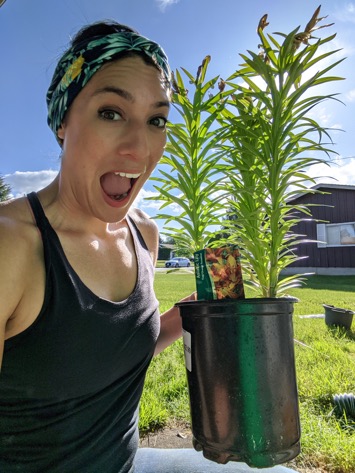
Being from Virginia and never visiting the Pacific Northwest before applying to UWS, I was a bit terrified to pick up and move across the country. Especially when all I knew about Portland was that it rained a lot. After I took the plunge and made the move, I am so happy that I did. Sure, it rains, but not nearly as much as I thought. The summer is also worth all those dreary days. I have a Jeep Wrangler that’s used to being flooded with a summer downpour at least once a week and I’ve been able to keep the top off all summer without flooding it once!
As a break from school, I really wanted to get into hiking and between Mount Hood, the Columbia River Gorge and the Oregon Coast – there are hundreds of hikes within two hours or less from Portland. Some even right in the city limits – hello Pittock Mansion and your beautiful views! I’ve had friends that have gone crabbing, skiing, rock climbing and kayaking. Oregon is home to some of the best outdoor activities. During this pandemic, it has been a sanity saver with all the amazing places to stay safe while will getting outside and enjoying yourself.
If you’re joining the UWS student family this fall or winter, you are not required to move to Portland just yet. I’d recommend moving to Portland if you’re able, both financially and with your COVID comfort-level. The first few quarters are tough and having a solid study group can really help you learn the material. There are a ton of on-campus resources that you will have access to such as the library and the UWS Health Center. Having chiropractic treatment in the clinic will help you build relationships with upper quarter students as well as get you familiar with how we treat patients here.
If you’re wanting to move to Portland, reach out to the admissions department and they can give you some advice on how to find housing. Personally, I found my roommates on our UWS student Facebook page and we found a house close to campus on Zillow. Even as an older student myself, it really helped me to live with other students, because we helped each other through the difficult parts of this program.
And if you aren’t able to move to Portland quite yet – don’t worry! Admissions is working on setting up some socials for you. There’s also a mentor program, student clubs such as the Student American Chiropractic Association (SACA) and the Student Canadian Chiropractic Association (SCCA) to help you build relationships with other students. It sounds cheesy to say, but we really are a family here at UWS.
Rosalia Messina, Ed.D., executive vice president of University of Western States
Rosalia Messina, Ed.D., executive vice president of University of Western States (UWS) has been elected to the Board of Directors of the Council on Chiropractic Education (CCE). CCE is the professional accrediting agency recognized by the United States Department of Education and the Council for Higher Education Accreditation to accredit doctor of chiropractic degree programs and chiropractic residencies.
Immediately following the CCE annual meeting in January 2021, Dr. Messina will be appointed to a three-year term as a CCE councilor. “It’s an honor to be elected to the Council on Chiropractic Education,” said Dr. Messina. “I am delighted to serve as a councilor to help advance the quality and integrity of chiropractic education.”
As a CCE councilor, Dr. Messina will be engaged in establishing accreditation standards and requirements, ensuring compliance with accreditation recognition criteria, reviewing program evaluation reports, and rendering decisions regarding the accreditation status of new and established doctor of chiropractic degree programs and chiropractic residencies.
“We are very proud of Dr. Messina’s election to the CCE,” said Dr. Joseph Brimhall, UWS president and CEO. “University of Western States values the accreditation process and Dr. Messina will be continuing a long-standing tradition of UWS representatives serving on recognized accrediting bodies.”
As UWS executive vice president, Dr. Messina serves as the primary representative for the president in facilitating community and government relations. She provides leadership for the integration of all university operations, including direct oversight of human resources, enrollment management, student services, communications and advancement. Dr. Messina holds a master’s degree in public administration with a focus in health policy from Portland State University, and a doctorate degree in education with a focus in interdisciplinary leadership from Creighton University.
The Council for Higher Education Accreditation (CHEA), the CHEA International Quality Group (CIQG), the Association of Specialized and Professional Accreditors (ASPA), the Federation of Chiropractic Licensing Boards (FCLB), the National Board of Chiropractic Examiners (NBCE), and governmental licensing boards recognize CCE as the accreditor for doctor of chiropractic degree programs and chiropractic residencies. The purpose of CCE is to promote academic excellence and to ensure the quality of chiropractic education.
By: Caitlin Jones, UWS doctor of chiropractic and sports medicine student
My first blog for University of Western States was about my trip this past January to Washington, D.C. with the Student American Chiropractic Association (SACA) to advocate for chiropractic care on the Hill. We usually advocate for multiple bills but this year the American Chiropractic Association (ACA) and SACA focused only on H.R. 3654, because it is so crucial for our Medicare patients to get the chiropractic treatment they need.
We just passed the one-year mark of Rep. Brian Higgins (NY) introducing H.R. 3654 to modernize chiropractic Medicare coverage. The last time Medicare’s chiropractic policy was updated was in 1972! If you think about our profession, how much has changed in the past decade let alone 48 years? As it stands, a patient with Medicare coverage can only see a chiropractic physician for spinal manipulation. If your wrist hurts or your chiropractic physician thinks that you need some soft tissue work or an x-ray – you would need to pay out-of-pocket if your insurance is Medicare. For these patients who are on fixed incomes, it is a struggle and they are unable to get the care that they need and are seeking.
Imagine that you go to your chiropractic physician for back pain and they think you may have a compression fracture. They suggest an x-ray but cannot perform or give you a referral, even though it is in their scope of practice. Instead, you need to go to your PCP to get a new physical exam, then a referral to a radiologist for the x-ray and then back to the chiropractic physician for treatment. What could have taken moments now takes weeks.
Because of this financial and time burden placed on Medicare patients, many chiropractic physicians are opting out of taking Medicare insurance. Medicare patients then go to their PCP for back or hip pain that could have been managed conservatively and instead they are prescribed pain medications. This has contributed to the opioid crisis that we have been struggling to overcome for years.
What the American Chiropractic Association (ACA) and SACA are asking for with H.R. 3654 is not an expansion of Medicare, it is to allow chiropractors to be able to treat their patients under the scope of their license. We want to give our patients the treatment they need for their pain and improve their quality of life.
What we need is for you to get involved! It has taken a little more than a year to get 82 co-sponsors and we need more to give this bill the best chance of going up for a vote. It only takes a moment to write or call your representative, let them know how this affects your patients (present and future!) and their constituents. Make it clear that this is a bi-partisan bill that does not expand coverage but allows chiropractic physicians to treat their patients properly.
Visit the ACA website where you can find FAQs and information about how to find your representative. Be sure to encourage others and reach out to your representative TODAY!
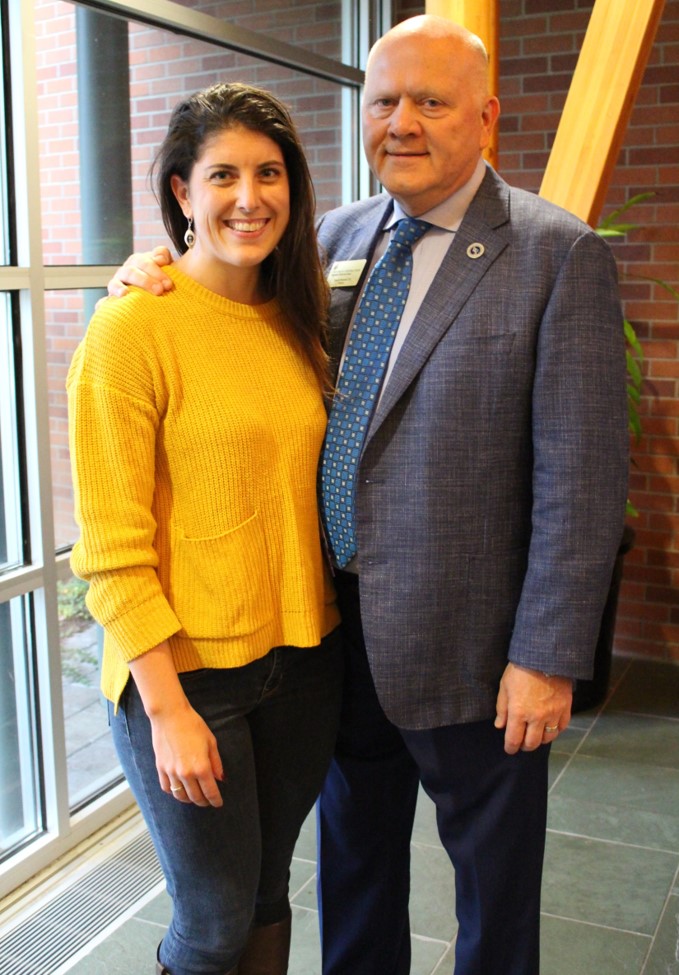
Dr. Stephanie Halloran and UWS President Dr. Joseph Brimhall at A Fond Farewell event on campus last fall.
Stephanie Halloran, DC, MS (class of 2016) has made her way back to University of Western States (UWS) as a new course facilitator in the human nutrition and functional medicine (HNFM) program. Dr. Halloran is an alumna of both the doctor of chiropractic and HNFM programs.
Currently, Dr. Halloran is also working on her postgraduate research fellowship at Yale Medical School on an integrative team that includes four other chiropractic physicians. The contingency’s project was funded by the U.S. National Institutes of Health (NIH), and National Center for Complementary and Integrative Health (NCCIH).
In addition, Dr. Halloran is also a part of an effort to launch a member directory for medically-integrated DCs called DC Integration.
“Connecting this subset of the profession could lead to increased training opportunities for students, residents or research opportunities in musculoskeletal areas,” said Dr. Halloran. “This effort encompasses more than just the VA, but also DoD (Department of Defense), university and private sector positions.”
Following graduation, Dr. Halloran completed her clinical rotation at the Richard Roudebush VA Medical Center with Christopher Sherman, DC, in Indianapolis and completed a one-year residency program with the VA Connecticut Health Care System with Anthony Lisi, DC.
Dr. Halloran sits on the American Chiropractic Association (ACA) Editorial Review Advisory Board, the National Association of Spine Specialists Legislative and the SpinePAC Committee. She also has served on the ACA planning task force for the annual meeting, ENGAGE (formerly NCLC).
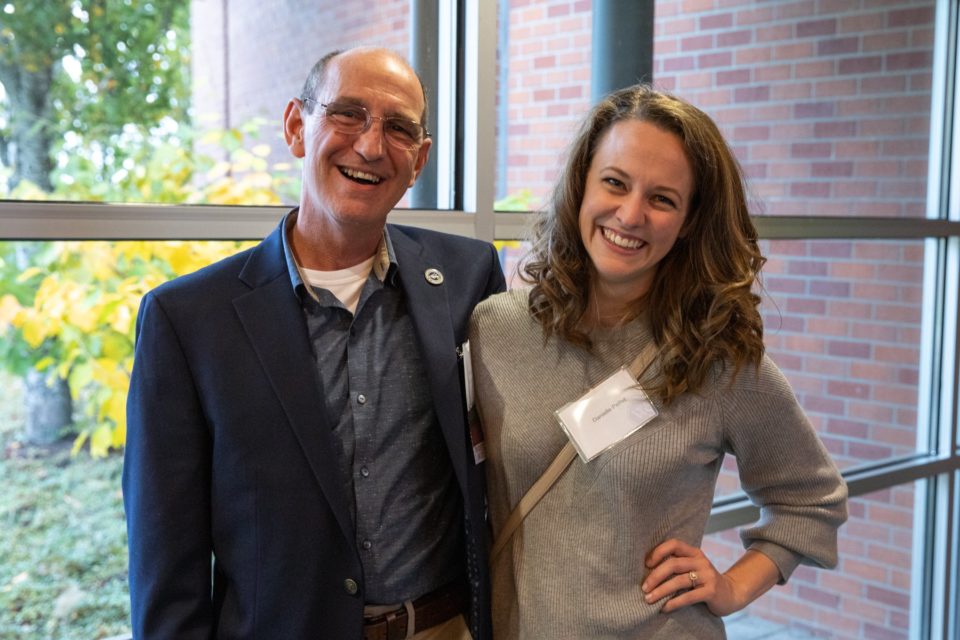
UWS board member and alumnus Dr. Mike Pettet (class of 2001) and his daughter and current doctor of chiropractic student, Danielle Pettet
Charitable giving, volunteering and giving back through mentorship are often values passed down from generation to generation. In the spirit of exploring how giving permeates throughout the family, we sat down for a Q&A with current doctor of chiropractic student, Danielle Pettet, and her father, current UWS board member, naming opportunity donor and alumnus, Dr. Michael Pettet.
Dr. Michael Pettet
Tell us a little more about the positive mentorship experiences you have had with UWS students.
The best experiences I have had while mentoring UWS students were when I had to stretch my knowledge, dust off a few cobwebs to answer a question, or research and learn a bit of new knowledge for myself. The second-best experience is watching a senior student or new associate gain experience and confidence. To see that glimmer of an “aha” moment in their eyes as the pieces fall into place in the real world is what it’s all about.
I make it a point to ensure that the students have a clear understanding of practice management and finances. Too often, new doctors are pulled into contracts with big promises that they can’t afford. UWS offers a free mentor network (Switchboard) that you should take advantage of, just reach out.
We need to be life-long learners and should want to pass that desire on to everyone we come in contact with. We may be considered experts, but you don’t know everything. A mentorship helps keep you up-to-date and keeps the humility real.
Why do you think it’s important for the previous generation of chiropractic physicians to mentor the upcoming generations?
I came to chiropractic after a 22-year career in the U.S. Marines Corps. Mentoring is in my blood (and yes, I was a drill instructor). Through the ranks, you are expected to train those below you and learn from those above. I strive to continue that mindset in this career. We are an evolving profession that has the potential to sit at all of the big tables of health care. To do that, we must share our own experiences, warts and all, with the next generation so that they can do better and go farther than we have.
The word mentor can have a lot of meanings: coach, advisor, counselor, teacher, instructor and more. The biggest benefit is having someone the mentee can meet with to ask questions, be a sounding board, help sort out options and give advice on practice and business matters. Mentoring is a one-on-one relationship where you have the opportunity to provide guidance to someone that could benefit from your experience.
What would you say to encourage other donors to make an impact such as you and your family did?
I give back to UWS and the profession that gave me the opportunity to be successful and help people as a thank you.
I want to see UWS grow in stature by helping support the next generation of students and alumni. The donation may be earmarked for research, scholarships or improved facilities.
Most graduates give back in proportion to their own gratitude and success. If you fall into the “I already gave enough with my tuition” category, go back and review the mentor comments above or reach out to me and let’s talk about how to be more successful.
What are you most excited about for the new UWS campus?
Everything! The location, design, learning spaces, laboratories, meeting rooms, study settings and don’t forget modern health care facility.
Danielle Pettet
Were you inspired by your father growing up to pursue an educational path in chiropractic medicine?
To be honest, I was actually more inspired by my mom’s theatre background growing up, so I have an undergraduate degree in theatre arts! It wasn’t until I was pregnant with my daughter that I realized just how life changing chiropractic care can be for a patient. After my daughter was born, I had an opportunity to work for my dad as his office manager and saw first had the impact he had on his patient’s quality of life. I was inspired by his ability to make connections with patients from all backgrounds, and provide them with the help they needed to feel better, and get back to doing the things they loved.
Upon graduation, what are your goals as a chiropractic physician?
After graduation, one of my goals is to make a positive impact on my community by educating patients about the benefits of chiropractic care. My other goal is to continue to be a mentor to chiropractic students, in addition to new docs, through the university’s mentor program. I consider myself extremely lucky to have access to so many mentors in this profession, it would be great to have a chance to return the favor.
With your parents being great examples in philanthropy and charitable giving, how do you envision yourself, your peers and others giving back to the next generations? Should that be an area past and future grads should be reminded of in terms of their alma mater?
My parents certainly set the bar high, and they have instilled in my sisters and I the importance of giving back however you can. Whether past and future grads choose to make a charitable donation or to donate their time to mentor an up-and-coming chiropractic student, the next generation benefits. The thing I love most about this school is that no matter what quarter you’re in, everyone is so supportive of one another; it just makes sense to continue lifting one another up after graduation.
By: Caitlin Jones, Q7 UWS doctor of chiropractic and sports medicine student
The Spring 2020 quarter was unlike any previous quarter I have ever had, even though I have taken online classes before. This was similar to previous doctor of chiropractic (DC) program quarters in that you’re constantly wondering how three months can seem like two days and five years all at the same time. It somehow goes by so fast, but it also feels like it just started. It was stressful, which is the norm, but a different kind of stress. One that was filled with constant change and having to adjust. These changes weren’t just school-related either. Travel was cancelled, hiking trails were closed, and most of my friends and both of my roommates went home for the entirety.
It was a lonely few months and I’m so thankful that I had school to keep me busy! Though there were a few weeks that it was a bit too busy. Thankfully, our professors were really responsive when they heard how crazy it was for us between the busy work and school load, so many adjusted their assignments to help. One week, a professor even told us that our assignment was to watch a five-minute video and go outside and enjoy the day. I literally cried I was so thankful. Acts like that truly saved my mental health as I was able to spend more time taking care of myself and picked up gardening, baking the quarantine banana nut bread, and going on a bazillion walks about the neighborhood – even walking by the old campus to make it feel a little more normal! Though I definitely had days where I really struggled, the activities that I picked up really helped me re-discover my passions and I’m in a better place mentally that I have been for the past year.
As I mentioned, I’ve taken online classes before and rarely got anything out of them in the past. It was always formatted to read something and then take a quiz. Although I don’t know if I would say that my knowledge on the material is what it would have been if we had class as normal, our professors are proficient in online lectures and making it interactive when needed. Even better, some professors are really slow talkers so that a 45-minute lecture can be watched in under 30 minutes! The hands-on portion was really tough, and I’m so thankful that we have a review the first week of next quarter. I know that our professors are going to do their best to get us up to speed as quickly as possible.
Though this quarter was extremely challenging and required everyone to shift their previous ways of thinking and doing, I’m really grateful for our professors that were with us every step of the way.
After suffering a TBI following a car accident, Leah Dash has found therapeutic relief mixing creativity and anatomy-inspired woodworking
By: Leah Dash, UWS doctor of chiropractic student
As with any college student, I’m always coming across things on Facebook that I can’t afford (thanks, advertising people). More than once have I seen something and then tried my hand at making my own version. However, these have always been small crafts like pennants, embroidery projects, etc. I have always enjoyed exploring different crafts, but it became even more important after I suffered a traumatic brain injury (TBI) in a car accident in July 2018. Doing small focused and detailed tasks is actually therapy for my brain. I am still in occupational therapy but things like this are helpful in managing my symptoms.
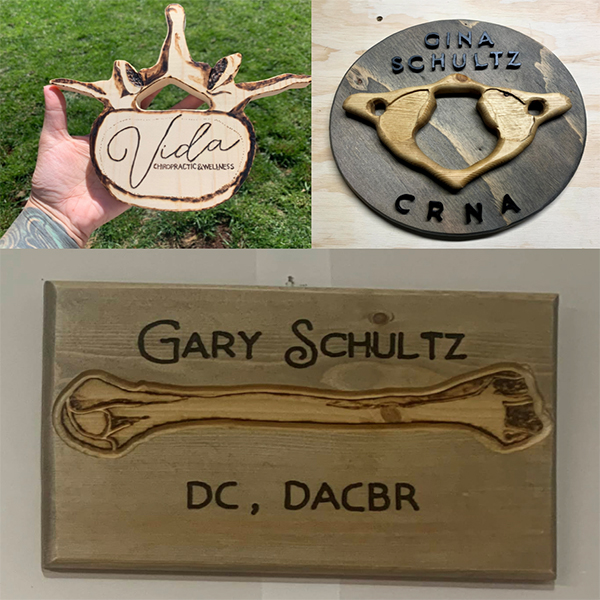
So, in January, when I saw a posting for a “Rustic Barnwood Atlas Vertebra” for $300, I was immediately in love. Rustic? Barnwood? That’s basically everyone’s interior design scheme right now. And anatomy? Spine related? I had to have it. However, that price tag… for what is essentially recycled wood, I couldn’t justify.
Where does anyone our age go when they need to learn a new skill (aside from chiro school)? YouTube.
I fell down the proverbial hole of YouTube. I watched every video I could find on how to cut basic wood shapes and figured I had to try to make one for myself. Finally, ready to start doing instead of watching, I went out and bought a jigsaw and started practicing. The first few were obviously terrible, but I slowly started to get the hang of it. At this point I also realized I was using the wrong tool and then purchased a used scroll saw off Facebook marketplace. I know I’d mentioned cost above and at this point it was at about $100 for both tools.
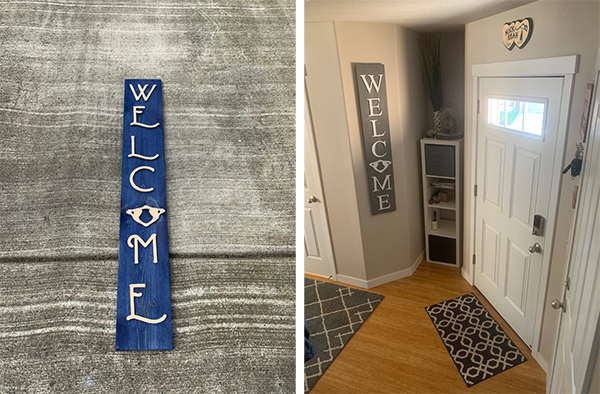
Inspired by some signs I saw on Pinterest and emboldened by my practice cuts, I decided to make a “Welcome” sign with the O replaced by an Atlas. This first attempt at lettering was pretty large, which is actually easier than making small cuts and was only a little wiggly, but let’s just call it “rustic,” ok? I then posted it on my Instagram and was surprised to receive a lot of attention from friends and local doctors. That was when I decided to sell a few to help offset the cost and make sure that I didn’t start hoarding wood vertebra.
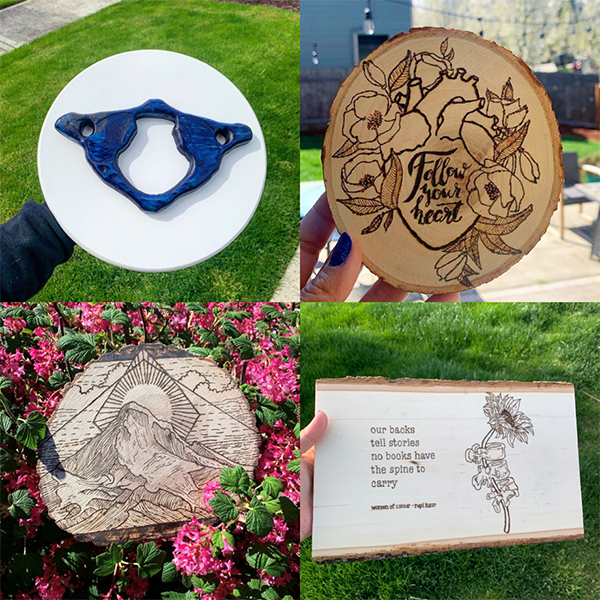
Most of what I make is anatomy based and I definitely consider the scroll saw to be my favorite tool. However, I also do a lot of pyrography, which is a woodburning technique that uses a heated pen to burn designs into wood. Obviously working on anatomy inspired pieces not only helps to improve my general knowledge (especially in Bone Path and other radiography courses), but it helps with my visual perception issues, such as perceiving a 3D object in space. I also have some issues with convergence and accommodation leftover by my TBI that are also helped by this “exercise” of focusing on the outline of my project on the scroll saw.
I’m also very thankful because when my fiancé lost his job at the beginning of quarantine, focusing on these projects, as well as the small amount of revenue, helped offset my anxiety and our grocery bills. I’m also very proud because he managed to get another job a week ago, despite the current economic crisis, so we’re on much firmer footing now. However, I have continued woodworking each week throughout the term and plan to continue in the future.
In my future practice, I hope to be able to display a lot of cute chiropractic things throughout the office, especially one of my Welcome signs. I also really love giving them as gifts to friends, so I hope to continue to be able to do that as well, as long as people don’t get sick of handmade gifts.
If anyone is interested in buying one of my signs or requesting a custom piece please follow my Instagram @spine.tree or you can email me [email protected]. Just please keep in mind that my student schedule is pretty crazy and these things take time.
Speaking of crazy schedules, if you have a hobby that you want to work on and feel like you don’t have time- it’s something that you just have to set time aside for. Just like the emphasis we place on physical health and the importance of movement; we need to remember that mental health is just as important. In my case, my brain firmly puts its foot down when it needs a break from studying but there are so many other signs from your body telling you that you need to go out there and do something that makes your heart happy. Also, if anyone wants to get into woodworking/woodburning let me know! I’m happy to help anyone on their crazy sawdust journey.
Hello and welcome! To provide you the best possible experience, our site uses cookies and third-party services to remember you, understand how you use our site, and improve the quality of our communication with you. We care about our visitors and want to ensure you are informed on how we use your data. Click here to learn more. By continuing to use the University of Western States website, you agree to how we use your data to improve service and user-experience.