What do food deserts, state licensing boards, and occupational therapy have in common? More than many future practitioners realize.
Occupational therapists have long played a critical role in assisting patients in regaining independence and improving daily functioning. Today, the profession continues to evolve as healthcare systems face growing pressure to address chronic illness, aging populations, rising costs, and unequal access to care.
As a result, occupational therapists need to think beyond individual treatment plans and must understand how external factors shape patient outcomes. This broader perspective defines systems-level occupational therapy.
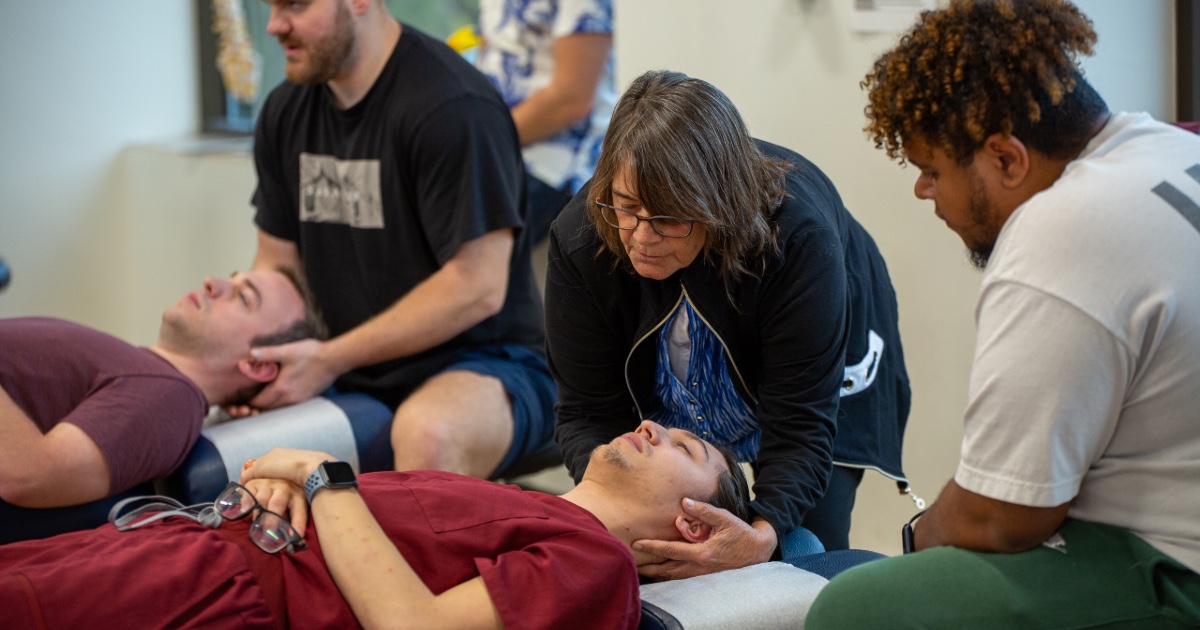
At University of Western States (UWS), students in the Doctor of Occupational Therapy (OTD) program learn how to advocate for patients in clinical settings and systems that influence health and well-being. Through a whole-person, evidence-informed approach, UWS prepares graduates to become leaders who can improve healthcare access, influence policy, and create meaningful change within their communities.
What Is Systems-Level Occupational Therapy?
Systems-level occupational therapy focuses on how environments, institutions, policies, and social systems influence a person’s daily life and health.
Daniel Martin, D.Sc., OTR/L, OTD research professor and Doctoral Capstone Coordinator, says, “When we look at a system, we’re looking at the definition of a system, which is a combination of parts that makes the whole work.”
“We’re talking about the roads, the quality of their water systems, access to transportation, and food deserts,” says Dr. Martin.
As healthcare becomes more population-centered, occupational therapists contribute to community-based and preventative models of care. This shift allows practitioners to address challenges before they escalate into long-term health complications. The UWS whole-person health approach recognizes the layered connection between external factors and well-being.
Why Does Population Health Matter in Occupational Therapy?
Occupational therapists support the goals of prevention by creating interventions that keep people active and independent within their communities.
Dr. Martin says, “We find that this is much more cost-effective and also helps keep people out of institutionalization.”
Occupational therapy’s holistic philosophy naturally supports this work because practitioners evaluate the full scope of a patient’s experience.
“The philosophies of OT, of looking at people on kind of a holistic level in terms of their physical performance, their cognitive performance, psychological performance, emotional performance, and spiritual performance, tend to lend themselves well to those kinds of community interventions,” says Dr. Martin.
How Do Occupational Therapists Advocate for Policy Change?
Policy plays a major role in determining who receives care, how services operate, and what resources remain available to communities. Due to this, occupational therapists can serve as important advocates within and outside of healthcare systems.
Dr. Martin says, “Systems-level OT is the balancing act of protecting the public but also honoring and furthering the scope and the science of occupational therapy.”
At UWS, policy and advocacy education form a foundational part of the OTD curriculum. Dr. Martin created a dedicated course focused specifically on policy, advocacy, and systems-level practice. In the course, OTD students learn how healthcare policy operates while also examining real-world examples of system failures.
He says, “I give them case law about what happens when these policies do not work.”
By studying situations where systems failed, students gain a deeper understanding of how advocacy can lead to meaningful reform.
Dr. Martin also conducts research focused on occupational therapy regulation and disciplinary trends. From a machine learning study, he published on the totality of OT state licensure board disciplinary cases, he developed an algorithmic tool that allows OT boards to quickly factor and document complex decisions for occupational therapy disciplinary cases, identifying larger systemic patterns and changes affecting practice and licensure oversight
This work allows UWS to continually update coursework with current policy developments affecting OTs today.
How Does UWS Teach Systems-Level Practice?
c integrates policy education into students’ clinical experiences so they can apply systems-level thinking in real time. During Level II fieldwork rotations, students participate in policy and advocacy coursework while actively working in clinical settings.
Dr. Martin says, “We very intentionally place the policy and advocacy coursework so they can immediately assimilate and synthesize all of this policy information while doing real clinical practice at the same time.”
This structure helps students identify how an organization’s systems are being challenged by the populations that they serve. Students also gain exposure to advocacy opportunities related to communities vulnerable to healthcare access, such as children, older adults, and people with disabilities.
Dr. Martin teaches systems-level advocacy from personal experience.
How Does UWS Prepare Students to Become OT Advocates?
In 2014, while practicing as an occupational therapist, Dr. Martin disagreed with a Maryland Board of Occupational Therapy Practice policy that prohibited OTs from using a particular treatment modality. Instead of accepting the limitation, he wrote a detailed letter to the board explaining why the policy created barriers for practitioners and patients. He also included research and evidence supporting why the modality should remain within the occupational therapy scope of practice.
The board took notice. After reviewing his letter, board members invited him to formally present his case. Following that presentation, they felt that his knowledge in pain management would be an asset and encouraged him to apply to sit on the board itself. He later became chairman of the Maryland Board of Occupational Therapy Practice, serving in that role for nearly a decade. While on the board, Dr. Martin helped reverse the very policy he originally challenged and championed additional systemic updates. He currently serves as a special investigator for the board.
“I just had the compulsion to jump into the matter,” he says. “That's my advice to a lot of students: to just do it, because when your lived experiences and knowledge combine, you can do things that have real lasting changes.”
Dr. Martin actively participates in the systems he now teaches about, and UWS students gain practical insight into how advocacy can create measurable change.
How Does Whole-Person Care Improve Occupational Therapy?
Occupational therapists examine physical, emotional, cognitive, and environmental factors simultaneously, and bring a broader perspective into healthcare organizations and interdisciplinary teams. Through these skills, OTs can help organizations identify service gaps and expand access for underserved populations.
Dr. Martin says, “OT does a really good job at looking at the person as a whole.”
Occupational therapists frequently identify opportunities other professionals may overlook due to the wide-ranging scope of practice OTs conduct.
This flexibility allows occupational therapists to support innovation across many settings, including hospitals, schools, rehabilitation clinics, workplace wellness programs, and community health initiatives.
How Do Occupational Therapists Improve Healthcare Organizations?
Occupational therapists often help organizations broaden the types of services they provide and the populations they can support.
Dr. Martin says, “OTs do a really good job of broadening the palette of a lot of the services that organizations can provide.”
Occupational therapists contribute specialized expertise that organizations may otherwise struggle to access. One example he points to is ergonomics. Through an understanding of performance, biomechanics, and environmental interaction, OTs can improve systems in ways that directly support patient participation and organizational effectiveness.
“OTs having that kind of Swiss Army knife perspective can do a really good job at filling in gaps,” says Dr. Martin.
At UWS, students learn how to integrate evidence-informed care with clinical reasoning and systems thinking. The program intentionally connects classroom learning with real-world practice experiences so graduates can confidently contribute within evolving healthcare systems.
How Can Occupational Therapists Advance Health Equity?
Healthcare disparities continue to affect many communities across the United States. Systems-level occupational therapists can play an important role in identifying barriers to care and improving accessibility.
Dr. Martin recently conducted research examining access to occupational and physical therapy (PT) services over more than two decades of patient data, where he found disparities in access to OT and PT services based on race.
The issue often lies in access to care rather than treatment quality once patients enter the healthcare system.
“The problem isn’t necessarily that OTs as a profession aren’t honoring the needs of people,” he says. “It’s just that there is a big swath of people, Black and Hispanic individuals in particular, who have a really hard time accessing OT services as a whole.”
This research reinforces why systems-level thinking matters. As Dr. Martin says, “The only way that we can move the needle on it is if we multiply professors passing down their systems-level knowledge and perceptions onto students.”
By exposing students to real-world inequities early in their education, UWS prepares future occupational therapists to advocate for sustainable, systems-level solutions throughout their careers.
How Does UWS Prepare Occupational Therapists to Lead Change?
University of Western States encourages future OTs to recognize the influence they can have within their communities.
Dr. Martin emphasizes that meaningful change often begins with awareness, curiosity, and a willingness to engage with complex problems. He says, “I tell students, ‘You have so much more power than you think you have.’”
By combining evidence-informed education with advocacy, leadership development, and whole-person care, UWS prepares graduates to create meaningful impact both inside and outside clinical settings.
Take the Next Step Toward Systems-Level Practice
If you're ready to become an occupational therapist who can improve lives at both the individual and systems levels, the UWS Doctor of Occupational Therapy program can help you get there. You'll gain the clinical knowledge, leadership skills, and advocacy experience to make a meaningful impact throughout your career. Fill out the brief form below to learn more about the program, connect with an admissions adviser, and discover how UWS can prepare you to lead the future of occupational therapy.